
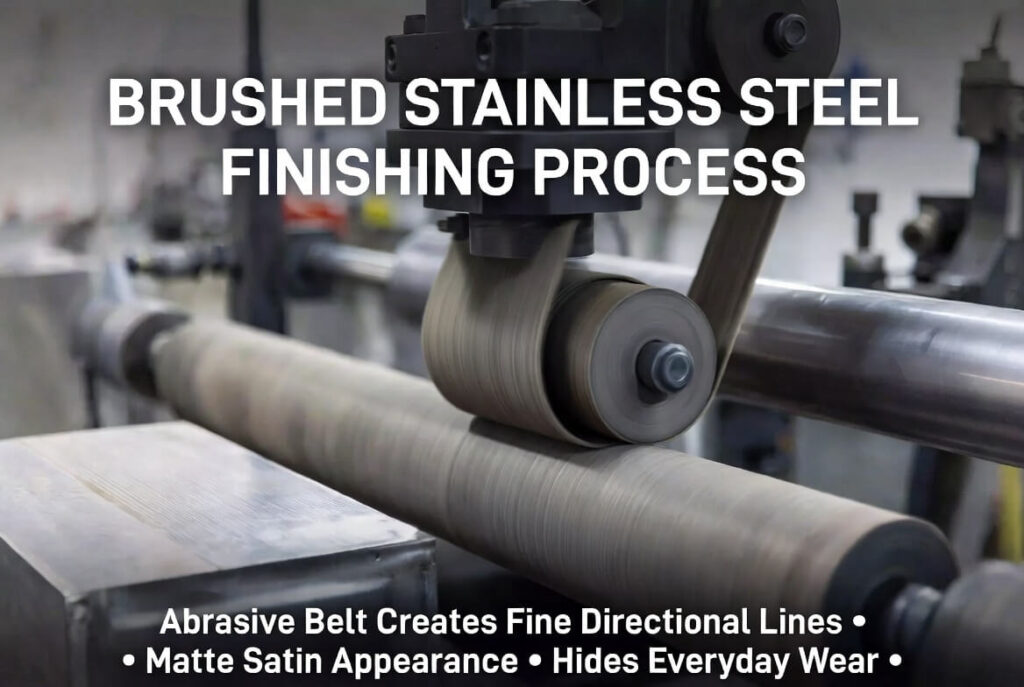
Brushed stainless steel stands out as one of the most practical and popular surface finishes for modern CNC machined parts. It starts with standard stainless steel (typically 304 or 316) and receives a controlled abrasive treatment that creates a distinctive matte look with fine, parallel lines running in one direction.
This finish delivers a clean, contemporary satin appearance while solving many real-world problems of highly reflective surfaces. It effectively hides fingerprints, minor scratches, and smudges, making it especially suitable for high-touch areas where parts need to stay looking good with minimal maintenance.
In this guide, we’ll cover what brushed stainless steel really is, how the finish is created, its main advantages, how it compares with other common stainless steel finishes, and when it makes the smartest choice for your CNC machining projects.
What Is Brushed Stainless Steel?
Brushed stainless steel is regular stainless steel that has been mechanically abraded to produce a non-reflective, matte surface with visible but subtle directional lines. Unlike mirror-polished stainless, it scatters light instead of reflecting it, resulting in a soft, sophisticated look that feels modern and professional.
The finish retains all the excellent corrosion resistance and strength of the base alloy while adding practical benefits for everyday use. It is widely favored in industries where both aesthetics and functionality matter.
How Brushed Stainless Steel Finish Is Created
Creating a quality brushed finish involves several careful steps to ensure uniformity and consistency, especially on CNC machined parts.
The process usually begins with thorough cleaning using alkaline or acidic solutions to remove oils, grease, and contaminants. Then, abrasive belts or wheels (commonly silicon carbide or aluminum oxide) are applied in a single direction. Manufacturers often start with coarser 60–120 grit to establish the base texture, followed by finer 120–180 grit for a smoother, more refined appearance. In some cases, greaseless compounds help achieve the final result.
After brushing, any remaining particles in the grooves are removed through deburring or light cleaning. For complex CNC components, automated equipment helps maintain consistent direction and depth across the entire surface.
Key Features and Benefits of Brushed Stainless Steel
The directional brushed texture brings several practical advantages that make it stand out:
- It significantly reduces glare, which is ideal in brightly lit environments or architectural settings.
- The fine parallel lines effectively mask fingerprints, light scratches, and smudges, helping parts maintain a clean appearance longer.
- Maintenance is straightforward — a simple wipe with a microfiber cloth is often sufficient, unlike polished surfaces that show every mark.
- It preserves the full corrosion resistance and mechanical strength of the underlying 304 or 316 stainless steel.
These features make brushed stainless steel particularly valuable for CNC machined parts that experience frequent handling or need to look professional over time without constant polishing.
Brushed vs Polished Stainless Steel: Clear Comparison
Brushed and polished finishes serve different purposes and suit different applications.
Polished stainless steel offers a bright, mirror-like shine with high reflectivity. While visually striking, it highlights every fingerprint, scratch, and smudge, requiring more frequent cleaning and maintenance. Brushed stainless steel, on the other hand, has low reflectivity and hides everyday wear much better, though it lacks the dramatic reflective “wow” factor.
Both finishes provide the same base corrosion resistance, but brushed is generally more forgiving in real-world, high-touch scenarios.
For a broader view, here’s how brushed stainless compares with other popular finishes:
| Finish Type | Appearance | Reflectivity | Scratch & Fingerprint Visibility | Best Applications |
| Polished | Bright mirror-like shine | High | Very visible | Decorative trim, jewelry, high-end appliances |
| Brushed | Matte with directional lines | Low | Well hidden | Kitchen equipment, architectural panels, electronics |
| Hairline | Very fine continuous lines | Medium | Fairly hidden | Consumer electronics, modern consumer products |
| Satin | Soft, smooth luster | Medium | Well hidden | Medical devices, hygienic surfaces |
Common Applications for Brushed Stainless Steel in CNC Machining
Brushed stainless steel works exceptionally well for CNC machined components that balance aesthetics with practical performance:
- Kitchen and food service equipment (refrigerators, ovens, range hoods, and counter trim) because it hides oil marks and fingerprints effectively.
- Architectural and interior elements such as wall panels, handrails, elevator interiors, and lighting fixtures, where low glare and a modern look are desired.
- Consumer electronics housings and enclosures that benefit from reduced fingerprint visibility.
- Automotive trim, industrial machinery panels, and furniture hardware.
It is especially suitable for environments where parts are frequently touched but do not require the ultra-smooth surface needed for strict medical sterilization.
Advantages and Potential Limitations
Brushed stainless steel offers an excellent balance of durability, low maintenance, and attractive appearance. It hides everyday wear better than polished options and provides a sophisticated look without excessive shine.
On the downside, the fine grooves in the brushed texture can occasionally trap dirt or residues over long periods, which may require more thorough cleaning in highly hygienic or food-contact situations. In applications where maximum reflectivity or an ultra-smooth surface is preferred, polished or satin finishes may still be the better option.
Choosing the Right Stainless Steel Finish for Your CNC Project
When selecting a finish, consider the usage environment, frequency of cleaning, lighting conditions, and desired visual effect. Brushed stainless steel is often the smartest choice when parts will see regular handling and you want them to maintain a clean, professional appearance with minimal effort.
For projects needing extreme hygiene or a luxurious mirror shine, polished finishes may be more appropriate. Working closely with an experienced CNC machining partner ensures you get consistent results across prototypes and production runs.
Ready to give your stainless steel parts a professional brushed finish? Our CNC team specializes in precision machining and a wide range of stainless steel surface treatments, including brushed, polished, satin, and custom finishes. We offer expert material advice, DFM feedback, and reliable finishing services to match your exact needs. Contact us today for a free quote or technical consultation. Let’s create durable, great-looking components that perform beautifully in real use.
FAQ
What is brushed stainless steel exactly?
It is standard stainless steel (usually 304 or 316) that has been mechanically brushed to create a matte, non-reflective surface with fine unidirectional lines.
How does brushed stainless steel compare to polished stainless steel?
Brushed finish has low reflectivity and hides fingerprints and scratches much better, while polished offers a bright mirror shine but shows marks easily and needs more maintenance.
Is brushed stainless steel easier to maintain?
Yes, in most daily situations. It conceals smudges and light wear effectively, though the texture may need occasional deeper cleaning than perfectly smooth surfaces.
What are the main applications for brushed stainless steel?
It is commonly used in kitchen appliances, architectural panels, electronic enclosures, automotive trim, and interior design elements where a modern matte look and practical durability are important.
Can brushed finish be applied to CNC machined parts?
Yes. The brushing process can be performed after CNC machining to achieve a uniform, high-quality finish on complex geometries for both prototypes and volume production.
Does the brushed finish affect corrosion resistance?
No. Corrosion resistance depends on the base stainless steel alloy, so brushed, polished, and other finishes provide the same level of protection.