
DLC Coating Services
DLC coating delivers exceptional hardness, ultra-low friction, and outstanding wear resistance. Ideal for high-performance components that face sliding, abrasion, or demanding operating conditions.
What Is DLC Coating?
Diamond-Like Carbon (DLC) coating is a thin-film surface treatment that deposits a hard, amorphous carbon layer onto the substrate. The coating combines properties similar to both diamond (high hardness) and graphite (low friction).
It is typically applied using Physical Vapor Deposition (PVD) or Chemical Vapor Deposition (CVD) methods. DLC is widely used in automotive, aerospace, tooling, medical, and precision engineering applications to improve wear resistance, reduce friction, and extend component lifespan. Different DLC formulations can be optimized for hardness, lubricity, or biocompatibility depending on the end use.
Advantages of DLC Coating
- Extremely high surface hardness
- Excellent wear and abrasion resistance
- Very low coefficient of friction
- Reduced heat generation during sliding contact
- Improved corrosion resistance
- Extended service life of tools and moving parts
- Thin coating with minimal dimensional impact
- Suitable for a wide range of substrates
DLC Coating FAQs
Does DLC coating wear off over time?
DLC coatings are highly durable and offer excellent wear resistance. While gradual wear can occur under extreme conditions, they typically last significantly longer than many conventional coatings.
Is DLC coating expensive?
DLC coating is generally more costly than standard finishes due to the specialized deposition equipment and process control required. However, the extended part life and reduced maintenance often justify the investment in high-wear applications.
What does DLC coating look like?
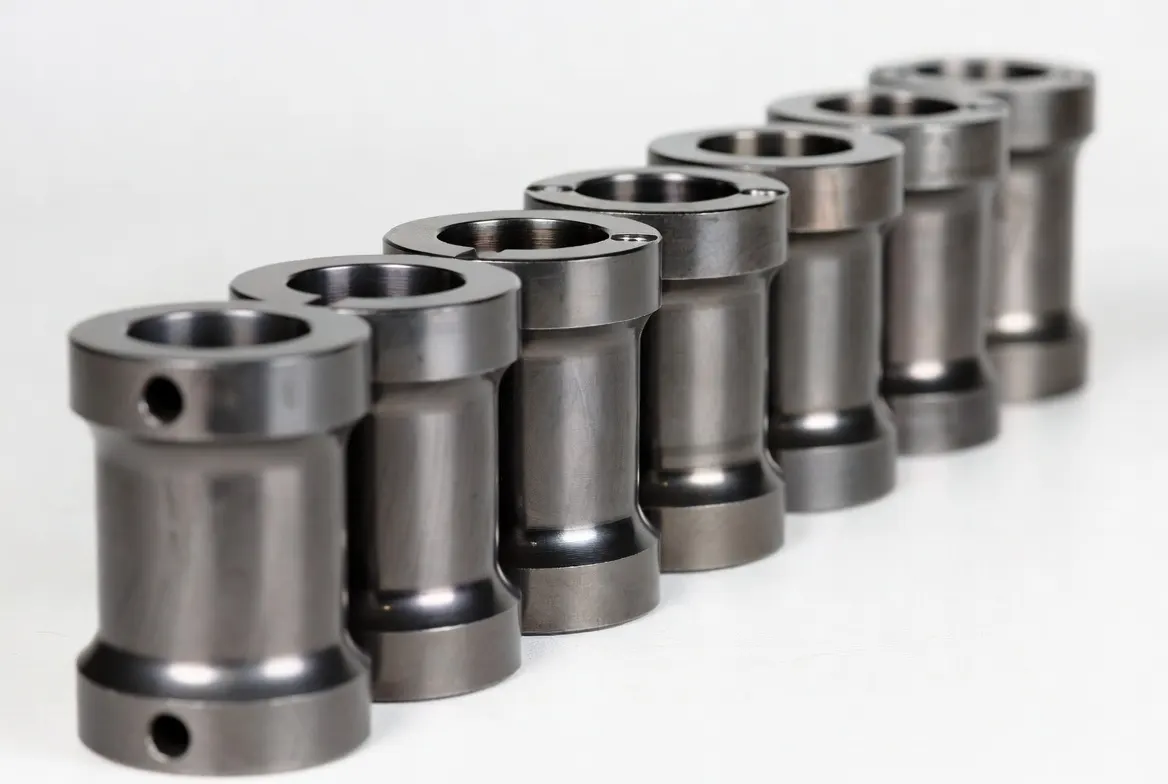
DLC coatings usually appear dark gray to black. The exact finish (matte or slightly glossy) depends on the specific DLC formulation and deposition parameters.
How much thickness does DLC coating add?
DLC coatings are typically very thin, ranging from a few tenths of a micron to several microns. They add minimal dimensional change, making them suitable for precision components.
Is DLC coating food-safe or biocompatible?
Certain DLC formulations are considered biocompatible and suitable for food-contact or medical applications. Compliance with specific regulatory standards should be confirmed based on the intended use.
Other Surface Finishing Processes
An electrochemical process that creates a durable, corrosion-resistant oxide layer on aluminum, enhancing hardness, wear resistance, and color options.
A surface finishing method that propels fine spherical media to clean, deburr, and create a uniform matte texture without significant material removal.
A chemical conversion coating that forms a thin black magnetite layer on ferrous metals, providing mild corrosion resistance and a non-reflective finish with minimal dimensional change.
An electrochemical process that removes a controlled layer of metal to produce a smooth, bright, and highly clean surface with improved corrosion resistance.
A controlled heating and cooling process used to modify the microstructure of metals, improving hardness, strength, toughness, and overall mechanical performance.
An electroplating process that deposits a uniform nickel layer to enhance corrosion resistance, wear protection, and surface appearance.
A dry finishing process in which electrostatically charged powder is applied and heat-cured to form a durable, uniform, and environmentally friendly protective coating.
A vacuum-based thin-film deposition technique that produces hard, wear-resistant, and often decorative coatings with excellent adhesion and minimal thickness.
An electroplating process that applies a sacrificial zinc layer to steel and iron parts, offering cost-effective corrosion protection through galvanic action.