
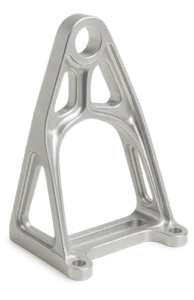


Bead Blasting for Custom Parts
Achieve a clean, uniform matte finish with professional bead blasting. Effectively remove rust, paint, scale, and surface contaminants while preparing parts for subsequent processes.
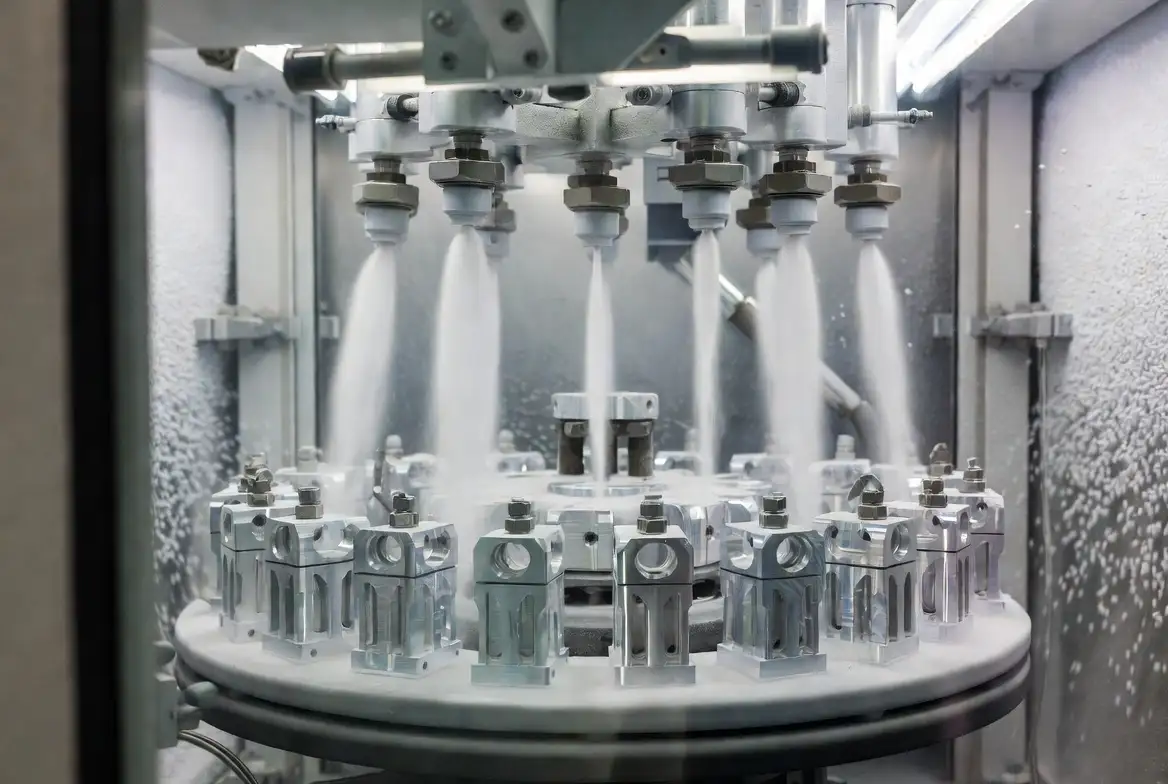
What Is Bead Blasting?
Bead blasting is a surface treatment process that propels fine spherical media—typically glass, ceramic, or metal beads—onto a workpiece at controlled pressure. The impact removes surface contaminants such as rust, oxide scale, and residual paint, while creating a consistent, non-directional texture.
The process is widely used for cleaning, deburring, and surface preparation in industries including automotive, aerospace, electronics, and precision manufacturing. By adjusting bead size, hardness, and air pressure, operators can achieve the desired finish without excessive material removal.
Advantages of Bead Blasting
- Effectively removes rust, scale, and contaminants
- Creates a uniform matte surface finish
- Improves adhesion for coatings and paints
- Suitable for both robust and delicate parts
- Minimal dimensional impact compared to aggressive abrasives
- Cost-efficient and relatively eco-friendly
- Versatile across metals, some plastics, and composites
Bead Blasting FAQs
What’s the difference between sandblasting and bead blasting?
Sandblasting typically uses angular abrasives such as sand or grit, which are more aggressive and can significantly alter the surface. Bead blasting uses spherical media (usually glass or ceramic beads), resulting in a smoother, more controlled, and less damaging finish.
Does bead blasting remove base material?
Bead blasting primarily removes surface contaminants and light residual material. When properly controlled, it causes minimal dimensional change, making it suitable for precision and delicate components.
Is bead blasting a coating process?
No. Bead blasting is a surface preparation and finishing method. It cleans and textures the surface, which can improve the performance of subsequent coatings, but it does not itself apply a protective layer.
Can bead blasting remove paint?
Yes. Bead blasting is effective at removing paint, coatings, and other surface residues without the aggressive material removal often associated with coarser abrasive methods.
Can plastic parts be bead blasted?
Yes, under carefully controlled conditions. Lower pressure and finer media are typically required to avoid surface damage or deformation of plastic components.
Other Surface Finishing Processes
An electrochemical process that creates a durable, corrosion-resistant oxide layer on aluminum, enhancing hardness, wear resistance, and color options.
A chemical conversion coating that forms a thin black magnetite layer on ferrous metals, providing mild corrosion resistance and a non-reflective finish with minimal dimensional change.
A thin diamond-like carbon film applied via PVD or CVD that delivers exceptional hardness, ultra-low friction, and superior wear resistance.
An electrochemical process that removes a controlled layer of metal to produce a smooth, bright, and highly clean surface with improved corrosion resistance.
A controlled heating and cooling process used to modify the microstructure of metals, improving hardness, strength, toughness, and overall mechanical performance.
An electroplating process that deposits a uniform nickel layer to enhance corrosion resistance, wear protection, and surface appearance.
A dry finishing process in which electrostatically charged powder is applied and heat-cured to form a durable, uniform, and environmentally friendly protective coating.
A vacuum-based thin-film deposition technique that produces hard, wear-resistant, and often decorative coatings with excellent adhesion and minimal thickness.
An electroplating process that applies a sacrificial zinc layer to steel and iron parts, offering cost-effective corrosion protection through galvanic action.