
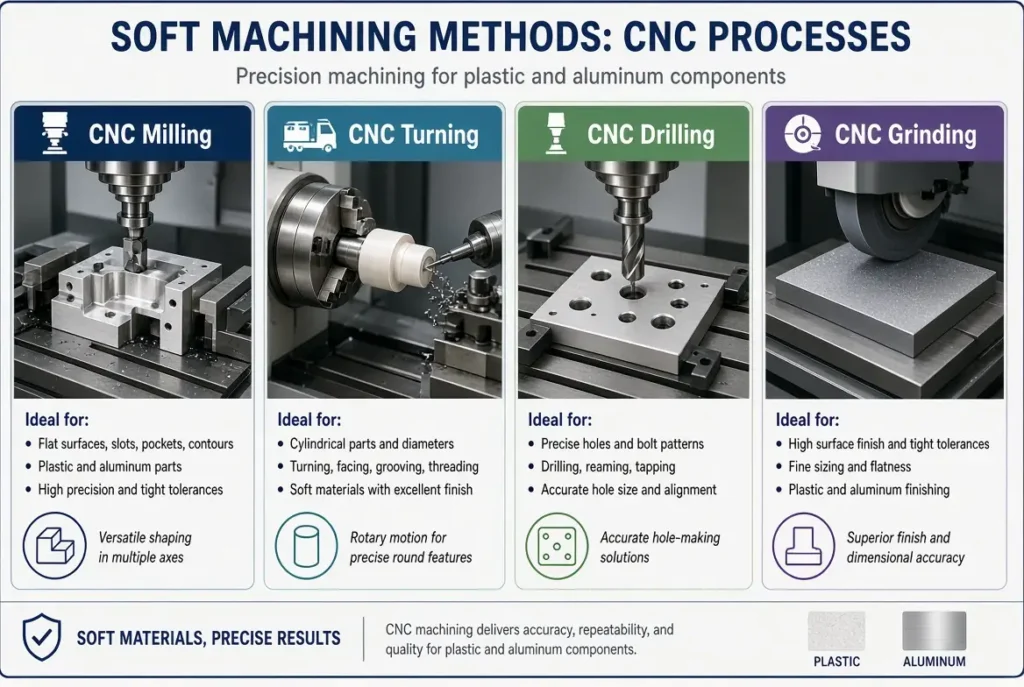
Soft machining is a CNC manufacturing approach that uses controlled, low cutting forces to shape materials with relatively low hardness and high ductility. It is commonly applied to plastics, non-ferrous metals (such as aluminum, brass, and copper), and composites — materials that do not require the extreme forces or specialized tooling needed for hardened steels.
This method is especially valuable in the early stages of product development and for low- to medium-volume production. It prioritizes speed, design flexibility, lower tooling costs, and reduced stress on the workpiece, making it ideal for prototypes, design iterations, jigs, fixtures, and functional parts where frequent changes are expected.
What Is Soft Machining?
In simple terms, soft machining refers to CNC processes performed on materials that are softer and more easily cut than hardened metals. Cutting forces remain relatively low, heat generation is moderated, and tool engagement is carefully controlled through shallow passes and optimized parameters.
The process typically involves repeated light cuts following programmed toolpaths. This approach minimizes residual stress, reduces the risk of deformation on thin walls or delicate features, and helps maintain dimensional accuracy. Soft machining is often used before any heat treatment (when applicable) or as a standalone method for materials that will not be hardened.
Tolerances commonly achieved range from approximately ±0.005″ for plastics to ±0.01 mm or better for many non-ferrous metals, depending on the machine, tooling, and material.
Main Soft Machining Methods
Soft machining is performed on standard 3-, 4-, and 5-axis CNC platforms using techniques adapted for lower forces:
CNC Milling Ideal for creating pockets, channels, contours, and complex 3D features. Climb or conventional milling strategies are selected based on material and geometry. It works well for engineering plastics, aluminum alloys (6061, 7075), brass, and certain composites.
CNC Turning Preferred for cylindrical parts such as shafts, tubes, housings, and bezels. Shallow depths of cut and controlled feed rates help prevent deflection and chatter. Soft jaws or collets are often used to distribute clamping pressure evenly.
CNC Drilling Requires careful pilot holes and chip evacuation, especially in plastics that can melt or deform. Multi-axis machines allow compound-angle holes without multiple setups. Air blast or mist coolant helps manage heat and chips.
CNC Grinding Used when superior surface finishes or tighter tolerances are needed. Fine-grit wheels and very light passes produce polished surfaces on materials like aluminum or clear acrylic while minimizing thermal damage.
The choice of method depends on part geometry, required surface finish, material properties, and production volume.
Materials Commonly Used in Soft Machining
Soft machining is optimized for materials typically in the lower hardness range (roughly below 40–45 HRC or equivalent):
| Material Category | Examples | Key Considerations |
|---|---|---|
| Thermoplastics | ABS, PC, PMMA (Acrylic), PTFE, Nylon, POM (Delrin) | Manage heat to avoid melting or smearing |
| Thermosets | Epoxy, polyurethane | Good dimensional stability |
| Elastomers & Foams | Silicone, rubber, PU foam | Low force, careful fixturing |
| Non-Ferrous Metals | Aluminum 6061/7075, Brass 360, Copper | Excellent chip control and surface finish |
| Composites | Carbon fiber, glass-filled plastics | Risk of delamination; use sharp or diamond-coated tools |
These materials benefit from polished or coated carbide tools, optimized speeds and feeds, and effective chip evacuation to maintain quality.
Soft Machining vs Hard Machining
| Aspect | Soft Machining | Hard Machining |
|---|---|---|
| Material Hardness | Lower (plastics, aluminum, brass, etc.) | Higher (typically >45 HRC after heat treatment) |
| Cutting Forces | Low to moderate | High |
| Tooling | Standard carbide (often coated or polished) | Specialized (CBN, ceramics, advanced coatings) |
| Material Removal Rate | Higher (faster bulk removal) | Lower (precision focus) |
| Heat Generation | Lower | Higher (requires robust cooling) |
| Typical Use | Prototypes, design iterations, low/medium volume | Final finishing of hardened high-performance parts |
| Cost & Flexibility | Lower upfront cost, easy design changes | Higher cost, less flexible once tooling is set |
Soft machining prioritizes efficiency and flexibility, while hard machining focuses on achieving final accuracy and surface integrity on hardened components.
Key Advantages of Soft Machining
- Lower tooling and production costs compared with hard tooling or hard machining
- Faster design iterations and shorter lead times (often days instead of weeks)
- Reduced tool wear and longer tool life
- Lower risk of workpiece deformation or residual stress
- Excellent for complex geometries and thin-walled features
- Ideal bridge between prototyping and higher-volume production
Limitations and Considerations
Soft machining is not suitable for materials that require high hardness or extreme wear resistance in their final state. Heat-sensitive plastics need careful parameter control to avoid melting or dimensional distortion. For high-volume production of hardened parts, transitioning to hard machining or dedicated hard tooling is usually more economical in the long run.
Common Applications
Soft machining is widely used in:
- Rapid prototyping and design validation
- Aerospace and automotive mock-ups or non-structural components
- Medical device housings and fixtures
- Consumer electronics enclosures
- Jigs, fixtures, and soft tooling
- Low- to medium-volume production of plastic and non-ferrous metal parts
Ready to use soft machining for your next project? Our CNC team specializes in precision machining of plastics, aluminum, brass, copper, and composites. Whether you need fast prototypes, design iterations, or low-to-medium volume production, we deliver high-quality parts with tight tolerances and quick turnaround. Contact us today for expert DFM feedback or a free quote.
FAQ
What is the difference between soft machining and hard machining?
Soft machining is performed on softer materials (or before heat treatment) using lower cutting forces. Hard machining is done on hardened materials (typically above 45 HRC) after heat treatment and requires specialized tooling.
What materials are suitable for soft machining?
Engineering plastics, aluminum, brass, copper, and many composites are commonly soft-machined. Hardened steels and high-hardness alloys are not.
Is soft machining cheaper than hard machining?
Yes, in most cases — especially for prototypes and lower volumes — because of lower tool wear, faster cycle times, and simpler setups.
Can soft machining achieve tight tolerances?
Yes. Well-controlled processes can achieve tolerances around ±0.005″ for plastics and ±0.01 mm or better for many metals, depending on the material and equipment.
When should I switch from soft machining to hard machining?
When the design is finalized, production volumes increase significantly, or the part requires the hardness and wear resistance that only post-heat-treatment machining can provide.