

When selecting materials for CNC machined components, alloy steel and stainless steel are two of the most common choices. Both offer excellent strength and versatility, but they differ significantly in composition, corrosion resistance, machinability, and cost. Choosing the wrong one can lead to premature rusting, excessive tool wear, or unnecessary expenses.
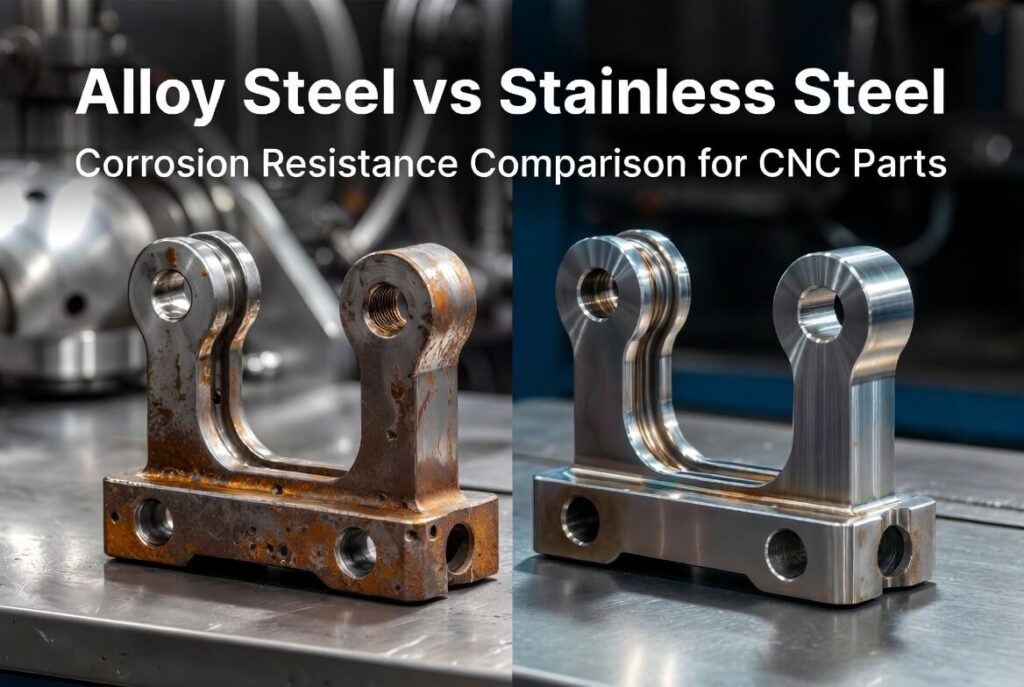
Alloy steel is enhanced with various elements to improve mechanical properties like strength, toughness, and wear resistance. Stainless steel, on the other hand, contains high chromium content that forms a protective oxide layer, giving it superior corrosion resistance.
This guide provides a clear, practical comparison to help engineers and manufacturers decide which material best suits their CNC machining projects.
What Is Alloy Steel?
Alloy steel is carbon steel that has been deliberately mixed with additional elements such as chromium, nickel, molybdenum, vanadium, or manganese to enhance specific properties. Common grades include 4140, 4340, and 8620.
These alloys are heat-treatable, allowing manufacturers to achieve very high strength, hardness, and toughness. Alloy steel is widely used when maximum mechanical performance is needed at a relatively lower cost compared to stainless steel.
What Is Stainless Steel?
Stainless steel is an iron-based alloy containing at least 10.5% chromium, which creates a self-healing passive oxide layer that protects against rust and corrosion. The two most common families are:
- Austenitic (e.g., 304 and 316) – excellent corrosion resistance and good formability.
- Martensitic (e.g., 410 and 440) – higher hardness but moderate corrosion resistance.
Stainless steel maintains its appearance and structural integrity even in harsh or moist environments, making it the preferred choice for food processing, marine, and medical applications.
Chemical Composition and Basic Differences
The core difference lies in their alloying elements:
- Alloy Steel: Contains varying amounts of carbon plus elements like Cr, Ni, Mo, V to boost strength and hardenability. Chromium content is usually below 5–8%.
- Stainless Steel: Minimum 10.5% chromium (often 16–18% or more in 304/316). Nickel is commonly added in austenitic grades for improved corrosion resistance and toughness.
This fundamental difference gives stainless steel its rust-resistant advantage, while alloy steel excels in raw mechanical strength and affordability.
Key Properties Comparison
Here’s a practical side-by-side comparison of the most important properties for CNC applications:
| Property | Alloy Steel (e.g. 4140) | Stainless Steel (e.g. 304/316) |
| Corrosion Resistance | Poor to moderate (needs coating) | Excellent (self-passivating) |
| Strength & Hardness | Very high after heat treatment | Good (can be heat treated in some grades) |
| Machinability | Good when annealed | Moderate to difficult (work hardens) |
| Cost | Lower | Higher (due to chromium & nickel) |
| Weldability | Good | Good to excellent (304/316) |
| Heat Treatability | Excellent | Limited in austenitic grades |
| Density | ~7.85 g/cm³ | ~7.93–8.00 g/cm³ |
Pro Tip: If your CNC parts will be exposed to moisture, chemicals, or outdoor conditions, stainless steel is usually the safer long-term choice. For high-load structural components in dry environments, alloy steel often provides better value.
Machinability for CNC Operations
Machinability is a critical factor in CNC production:
- Alloy Steel: Generally machines well, especially in the annealed condition. It produces good chip control and allows higher cutting speeds. However, when heat-treated to high hardness, tool wear increases significantly.
- Stainless Steel: More challenging due to work-hardening, especially austenitic grades like 304 and 316. It tends to create built-up edge on tools and requires sharp carbide tools, lower speeds, and generous coolant. Martensitic grades can be even harder after heat treatment.
For high-volume CNC runs, alloy steel often results in faster cycle times and lower tooling costs, while stainless steel may require more careful parameter optimization.
Corrosion Resistance and Environmental Suitability
This is where the two materials diverge most clearly:
- Alloy Steel: Offers limited natural corrosion resistance. It rusts easily in humid or salty environments unless protected with coatings, plating, or painting.
- Stainless Steel: Provides excellent resistance to rust and oxidation. Grade 316 performs particularly well in marine and chemical environments due to added molybdenum.
If your parts will face moisture, food contact, or outdoor exposure, stainless steel is almost always the better choice despite its higher price.
Common Applications in CNC Machining
Alloy Steel is preferred for:
- Automotive and heavy machinery components (gears, shafts, crankshafts)
- Tooling, molds, and dies
- High-strength structural parts in dry conditions
- Cost-sensitive, high-load applications
Stainless Steel is preferred for:
- Food processing and medical equipment
- Marine hardware and architectural components
- Chemical processing parts
- Any application where long-term corrosion resistance is essential
Many manufacturers use alloy steel for internal structural parts and switch to stainless steel for visible or exposed components.
Cost Considerations
Alloy steel is generally 20–50% less expensive than stainless steel, depending on the specific grades and market conditions. However, when factoring in coatings, maintenance, or potential part replacement due to corrosion, stainless steel can deliver better long-term value in aggressive environments.
Always evaluate total cost of ownership rather than just raw material price.
How to Choose Between Alloy Steel and Stainless Steel
Consider the following questions when making your decision:
- Will the part be exposed to moisture, chemicals, or outdoor conditions?
- How important is maximum strength versus corrosion resistance?
- What is the expected production volume and machining budget?
- Does the part require heat treatment for higher hardness?
For dry, high-strength, cost-sensitive applications — choose alloy steel. For corrosion-prone or hygienic environments — choose stainless steel.
Conclusion & Recommendation
There is no universal winner between alloy steel and stainless steel. The best material depends on balancing mechanical requirements, environmental exposure, machinability, and budget. Alloy steel offers superior strength-to-cost ratio in controlled environments, while stainless steel provides unmatched durability and appearance where corrosion is a concern.
Working with an experienced CNC machining partner early in the design phase can help you select the optimal material and avoid costly mistakes.
Ready to choose the right material for your CNC project? Our team specializes in both alloy steel and stainless steel machining. We provide expert material recommendations, DFM feedback, heat treatment services, and precision CNC production. Contact us today for a free consultation or quote. Let’s deliver strong, reliable, and cost-effective parts tailored to your exact needs.
FAQ
What is the main difference between alloy steel and stainless steel? The primary difference is corrosion resistance. Stainless steel contains high chromium that forms a protective layer, while alloy steel focuses on enhanced mechanical properties through various alloying elements.
Which is stronger — alloy steel or stainless steel? Alloy steel can achieve higher strength and hardness after heat treatment, but stainless steel offers better overall performance in corrosive environments.
Is stainless steel harder to machine than alloy steel? Yes. Stainless steel tends to work-harden and creates more tool wear, making it more challenging to machine than most alloy steels in the annealed condition.
Can alloy steel rust? Yes, alloy steel has poor natural corrosion resistance and will rust without protective coatings or plating.
Which is better for outdoor applications? Stainless steel is generally better for outdoor or marine use due to its excellent corrosion resistance. Alloy steel requires additional protection.
Which material is more expensive? Stainless steel is typically more expensive than alloy steel due to higher chromium and nickel content.