

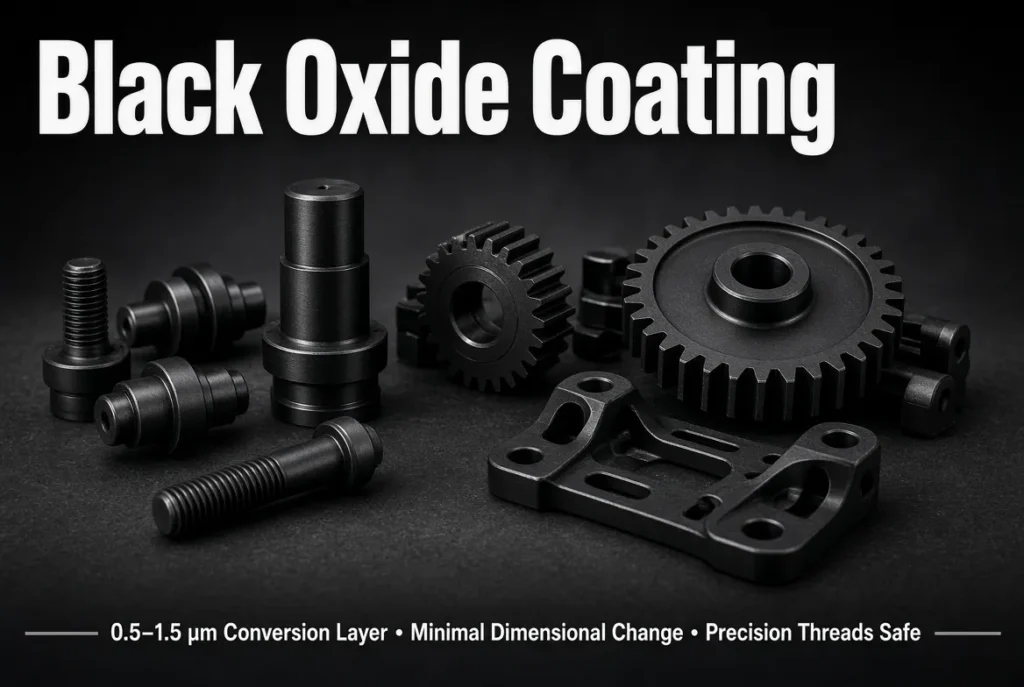
Blackening coating, also called black oxide, is a chemical conversion process that turns the outer surface of ferrous metals into magnetite (Fe₃O₄). Unlike plating or paint, it does not deposit a separate layer. The surface iron itself reacts and becomes the black oxide film.
The resulting layer is typically 0.5–1.5 µm thick. That thickness is small enough that most CNC parts keep their original dimensional tolerances, thread fits, and press-fit clearances after treatment.
How Blackening Coating Works
The process is a controlled chemical reaction, not a coating application.
Clean steel is immersed in an alkaline oxidizing bath containing sodium hydroxide plus nitrates or nitrites. Iron at the surface reacts to form magnetite:
3 Fe + 4 H₂O → Fe₃O₄ + 4 H₂ (simplified)
The magnetite layer grows both into and slightly outward from the original surface. Because it is integral to the metal, it does not chip or peel the way a deposited coating can.
After the bath, parts are rinsed and immediately sealed with oil, wax, or a similar preservative. The oxide film is porous by design; the sealer fills those pores and provides most of the practical corrosion protection. Without sealing, the bare black oxide offers very little rust resistance.
Process Types and Operating Conditions
Three temperature ranges are used in industry.
Hot black oxide runs at approximately 141–146 °C (285–295 °F). This is the traditional industrial process and produces the most durable magnetite finish. It is the method referenced by most military and aerospace specifications (MIL-DTL-13924, AMS 2485).
Mid-temperature black oxide operates around 93–99 °C (200–210 °F). It forms a similar magnetite layer with lower energy use and reduced fume risk.
Cold (room-temperature) blackening works near ambient temperature. Many cold processes deposit a copper-selenide film rather than true magnetite. The finish is thinner, less abrasion-resistant, and mainly cosmetic.
For precision CNC components where functional performance matters, hot or mid-temperature processes are preferred.
Typical sequence:
- Alkaline cleaning to remove machining oils and soils
- Acid pickle or descaling if scale or rust is present
- Rinse
- Black oxide immersion (5–40 minutes depending on alloy and bath)
- Rinse
- Immediate oil or wax seal
Surface preparation quality directly determines final appearance. Black oxide follows the existing topography; it does not fill tool marks or hide poor surface finish.
Dimensional Effect on CNC Parts
Because blackening is a conversion rather than a deposited coating, the dimensional change is minimal—usually under 2 µm total.
This property makes it suitable for:
- Threaded features (Class 2A/2B and tighter fits remain usable)
- Precision shafts and bores
- Gauge and fixture components
- Parts with tight press or slip fits
In contrast, zinc plating commonly adds 5–25 µm per surface and powder coating adds 25–125 µm. Those build-ups force designers to undercut features during machining or accept post-finish dimensional risk. Blackening avoids that trade-off.
Note that the layer still grows slightly outward. On ultra-critical features tighter than ±0.005 mm, confirm the exact expected thickness with the finisher and, if needed, machine a small compensation.
Corrosion Resistance and Limitations
Bare black oxide provides almost no meaningful corrosion protection. The magnetite film is porous; moisture and oxygen still reach the steel.
Protection comes from the post-treatment seal. With a proper oil or wax impregnation, the finish can withstand mild indoor or controlled-humidity environments. In salt-spray or outdoor exposure the sealed coating still fails relatively quickly compared with zinc plating or powder coating.
Blackening is therefore not appropriate for:
- Marine or continuous outdoor service
- High-abrasion contact surfaces
- Environments where the oil film cannot be maintained
It is appropriate when the primary needs are appearance, light corrosion delay, oil retention, reduced glare, and strict dimensional control.
Material Compatibility
The process works on carbon steel, alloy steel, and many low-alloy steels. Stainless steels can be blackened with specialized chemistries, but results vary by grade and require process validation.
Aluminum, copper alloys, and most non-ferrous metals do not form the same magnetite layer and are not candidates for standard blackening.
When to Specify Blackening Coating
Choose blackening when all of the following apply:
- The part is ferrous
- Dimensional change must stay under a few micrometers
- Corrosion exposure is mild and a sealed surface is acceptable
- A uniform matte or semi-gloss black appearance is desired
- Cost is lower than plating or organic coatings for the required volume
Do not choose it when the part will see aggressive corrosion, heavy wear, or when a thicker barrier coating is needed.
Relation to Other Surface Finishes
| Finish | Typical Thickness | Dimensional Impact | Corrosion Level (sealed) | Best Use Case |
|---|---|---|---|---|
| Blackening (hot) | 0.5–1.5 µm | Negligible | Mild | Precision steel parts, threads |
| Zinc plating | 5–25 µm | Significant | Good | General corrosion protection |
| Powder coating | 25–125 µm | Large | Excellent | Outdoor or high-wear appearance |
| Electroless nickel | 5–50 µm | Significant | Very good | Wear + corrosion on complex shapes |
Blackening occupies the narrow niche where dimensional fidelity outweighs heavy corrosion protection.
Practical Notes for CNC Design and Procurement
- Specify the process type (hot preferred for functional parts) and the required sealant.
- Call out critical dimensions and whether any compensation is needed.
- Expect the final appearance to reflect the machined surface finish; request a ground or polished surface if a deep, uniform black is required.
- Confirm the finisher follows a recognized specification if the part is for aerospace, defense, or regulated industries.
- Plan for re-oiling in service if the part will see repeated handling or cleaning that removes the original sealant.
Blackening coating remains one of the few surface treatments that can deliver a functional black finish on tight-tolerance CNC steel parts without forcing designers to redesign clearances or accept plating build-up.
FAQ
Q: Does blackening coating affect thread fit?
A: No meaningful effect for standard and most precision threads. Thickness is typically under 2 µm.
Q: Is black oxide the same as cold blackening?
A: Not always. Hot and mid-temperature processes form true magnetite; many cold processes deposit a different film with lower durability.