

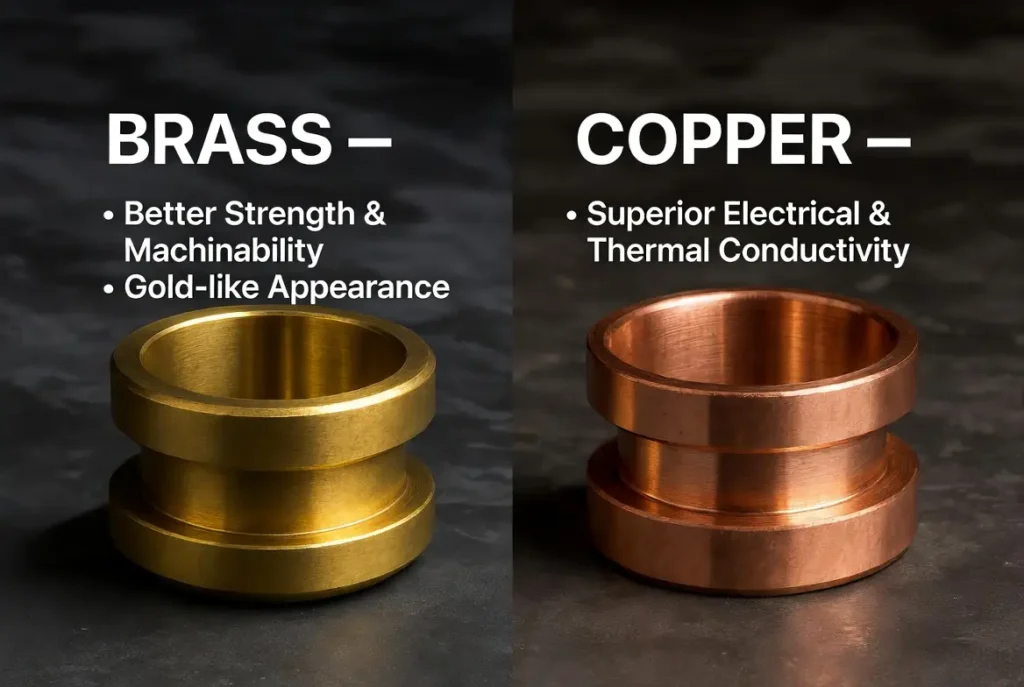
When selecting materials for CNC machined components, brass and copper frequently come up as top non-ferrous options. Both metals offer excellent corrosion resistance, aesthetic appeal, and good workability, but they serve very different purposes due to fundamental differences in composition and performance.
Pure copper excels in electrical and thermal conductivity, making it ideal for wiring, heat exchangers, and electronic parts. Brass, a copper-zinc alloy, provides greater strength, better machinability, and a gold-like appearance, suiting it for fittings, valves, decorative hardware, and precision mechanical components.
Choosing incorrectly can affect conductivity, tool life, surface finish, part durability, or project cost. This guide delivers a detailed, side-by-side comparison to help engineers and manufacturers select the optimal material for CNC projects.
What Is Copper?
Copper (Cu) is a pure elemental metal known for its distinctive reddish-orange color. It is soft, highly ductile, and valued primarily for its outstanding electrical conductivity (approximately 59.6 × 10⁶ S/m) and thermal conductivity (around 400 W/m·K). These properties make pure copper the standard for electrical wiring, busbars, and heat transfer applications.
Copper is also highly workable — it can be bent, drawn, or formed by hand — and develops a protective patina over time that enhances long-term corrosion resistance. Common grades for CNC machining include C11000 (electrolytic tough pitch copper).
What Is Brass?
Brass is an alloy primarily composed of copper and zinc (zinc content typically 5–40%). Additional elements like tin, iron, or lead may be added to enhance specific traits such as corrosion resistance or machinability. The higher zinc content gives brass a bright yellowish, gold-like appearance and improves mechanical strength compared to pure copper.
Brass is non-ferromagnetic and offers a good balance of strength, ductility, and ease of processing. Popular free-machining grades like C36000 are favorites in CNC shops for high-volume production.
Appearance Comparison
- Copper: Reddish-orange hue, often called “red metal.” Develops a natural brown or green patina over time.
- Brass: Yellow to golden color resembling gold. The exact shade varies with zinc content — higher zinc produces a brighter yellow.
Brass is widely chosen for decorative and architectural CNC parts where aesthetics matter, while copper’s warm red tone suits electrical or traditional plumbing applications.
Physical and Mechanical Properties Comparison
Here is a summary of key properties (based on common grades C11000 copper and C26000/C36000 brass):
| Property | Copper (C11000) | Brass (C26000 / C36000) |
| Density (g/cm³) | 8.96 | 8.53 |
| Melting Point (°C) | 1,085 | 915–940 |
| Thermal Conductivity (W/m·K) | ~400 | ~120 |
| Electrical Conductivity (×10⁶ S/m) | 59.6 | ~28 |
| Tensile Strength (MPa) | 200–250 | 300–550 |
| Yield Strength (MPa) | 70–150 | 100–400 |
| Elongation (%) | 40–60 | 10–50 |
| Hardness (Brinell) | 40–50 | 70–150 |
Key Takeaways:
- Copper offers superior conductivity but is softer and more ductile.
- Brass provides higher strength and hardness with reduced ductility.
- Brass work-hardens faster but generally machines more cleanly.
Pro Tip: For high-precision CNC parts requiring tight tolerances and excellent surface finish, free-machining brass often outperforms pure copper due to better chip control and lower tool adhesion.
Corrosion Resistance
Both materials resist corrosion well, but differences matter:
- Copper: Excellent corrosion resistance, especially in atmospheric and many chemical environments. Forms a protective patina that slows further degradation — ideal for outdoor plumbing, roofing, and marine tubing.
- Brass: Good general corrosion resistance, but high-zinc brasses can suffer from dezincification (selective zinc leaching) in aggressive waters or acidic conditions. Tin-added brasses (e.g., naval brass C46400) improve performance in seawater.
For harsh or marine CNC applications, copper or specialized brass alloys are preferred.
Electrical and Thermal Conductivity
Copper dominates here:
- It is the benchmark for electrical wiring and components needing maximum conductivity.
- Brass conductivity drops to roughly 25–50% of copper’s depending on zinc content, but remains sufficient for many connectors, terminals, and low-current applications where added strength is beneficial.
Thermal performance follows the same trend — copper is preferred for heat sinks, exchangers, and cookware, while brass suits structural parts with moderate heat transfer needs.
Machinability for CNC Operations
This is a major differentiator in CNC shops:
- Brass: Excellent machinability, especially free-machining grades (C36000). It produces short, clean chips, reduces built-up edge, allows higher speeds and feeds, and delivers superior surface finishes with less tool wear. Ideal for high-volume precision parts like fittings, gears, valves, and connectors.
- Copper: Fair to good machinability but more challenging. It is gummy/soft, leading to stringy chips, tool buildup, and potential surface smearing. Requires sharp tools, optimized coolant, and slower parameters. Pure copper is best for low-volume or conductivity-critical parts.
Important Note: Brass often reduces cycle times and tooling costs in CNC milling, turning, and drilling, making it more economical for complex geometries despite slightly higher material cost in some cases.
Common Alloys and Their Uses
Brass Alloys:
- Cartridge Brass (C26000): Excellent cold working — used for decorative items, automotive parts, and casings.
- Naval Brass (C46400): High corrosion resistance in marine environments — propellers, fittings, hardware.
- Tin Brass / Red Brass: Enhanced corrosion resistance for plumbing and decorative trim.
Copper Alloys (for reference):
- Pure copper (C11000) for electrical applications.
- Other copper alloys like phosphor bronze or aluminum bronze expand options for wear or strength needs.
Typical Applications in CNC Machining
Choose Copper when you need:
- Maximum electrical or thermal conductivity (wiring terminals, busbars, heat exchangers, RF components).
- High ductility for forming or flexible parts.
- Superior long-term corrosion resistance in specific environments.
Choose Brass when you need:
- Better strength and wear resistance combined with good machinability (valves, fittings, gears, nozzles, musical instruments, decorative hardware).
- Aesthetic golden finish for visible parts.
- Cost-effective high-volume CNC production with tight tolerances.
Many manufacturers use brass for mechanical precision components and copper for pure conductivity roles.
Cost Considerations
Copper is generally more expensive due to its purity and high demand in electrical industries. Brass is often more cost-effective for machining because of faster production rates and lower tool wear, even if raw material prices are comparable or slightly lower. Always evaluate total part cost including machining time, scrap, and performance requirements.
How to Choose Between Brass and Copper for Your CNC Project
- High conductivity critical?→ Select copper.
- Strength, machinability, and aesthetics important?→ Choose brass.
- Marine or corrosive environment?→ Evaluate specialized brass (tin-added) or copper.
- High-volume precision parts?→ Brass usually wins on cycle time and finish.
- Budget and long-term durability?→ Balance material price with machining efficiency and service life.
Review part function, operating conditions, and tolerances early with your CNC partner.
Ready to machine your next brass or copper project with confidence? Our expert CNC team specializes in non-ferrous alloys including brass and copper. We provide material recommendations, DFM feedback, tight-tolerance machining, and fast turnaround. Contact us today for a free quote, technical consultation, or help selecting the ideal material for your application. Let’s deliver high-quality components that meet your exact performance and aesthetic needs.
FAQ
What is the main difference between brass and copper?
Copper is a pure metal with superior electrical and thermal conductivity, while brass is a copper-zinc alloy offering higher strength, better machinability, and a gold-like appearance.
Which has better electrical conductivity — brass or copper?
Copper has significantly higher electrical conductivity (about twice that of typical brass), making it the preferred choice for wiring and high-current applications.
Is brass easier to machine than copper in CNC?
Yes. Brass, especially free-machining grades, produces cleaner chips, allows higher speeds, and reduces tool wear compared to the gummy nature of pure copper.
Which is more corrosion resistant?
Copper generally offers superior corrosion resistance and forms a protective patina. Brass performs well but can suffer dezincification in certain aggressive environments unless modified with tin or other elements.
Does brass cost more than copper?
Material costs vary with market prices, but brass often provides better overall value in CNC production due to faster machining and lower tooling costs.
Can brass and copper be used together?
Yes, but galvanic corrosion should be considered in wet or electrolytic environments. Proper design or coatings can mitigate risks.
Which is better for decorative CNC parts?
Brass is usually preferred for its luxurious gold-like finish and polishability, while copper suits rustic or industrial aesthetic applications.
Is brass magnetic?
No, standard brass is non-magnetic, similar to copper.