

A common question in engineering and CNC machining is: Is brass magnetic?
The short answer is no — standard brass is non-magnetic (non-ferromagnetic). This property makes brass an excellent material choice for precision components where magnetic interference must be avoided, such as electronic connectors, sensor housings, RF shielding, and marine hardware.
However, real-world situations can sometimes cause confusion. Brass-plated steel parts may appear magnetic, and certain specialty brass alloys with trace elements can show very weak responses. Understanding the science behind brass magnetism helps designers and machinists make better material decisions.
This guide explains why brass is non-magnetic, how it compares with similar metals, its practical implications for CNC machining, and how to test brass in the shop.
Why Brass Is Non-Magnetic: The Science
Brass is an alloy primarily made of copper and zinc (typically 55–95% copper and 5–45% zinc). Both copper and zinc are non-ferromagnetic metals.
Ferromagnetism requires unpaired electrons in the atomic structure that can align to create a persistent magnetic field. Copper and zinc have fully paired electron configurations in their d-orbitals, so brass cannot retain magnetism or strongly attract to a permanent magnet under normal conditions.
In simple terms: brass behaves as a diamagnetic material, showing only extremely weak repulsion in very strong magnetic fields — an effect too subtle to notice in everyday use.
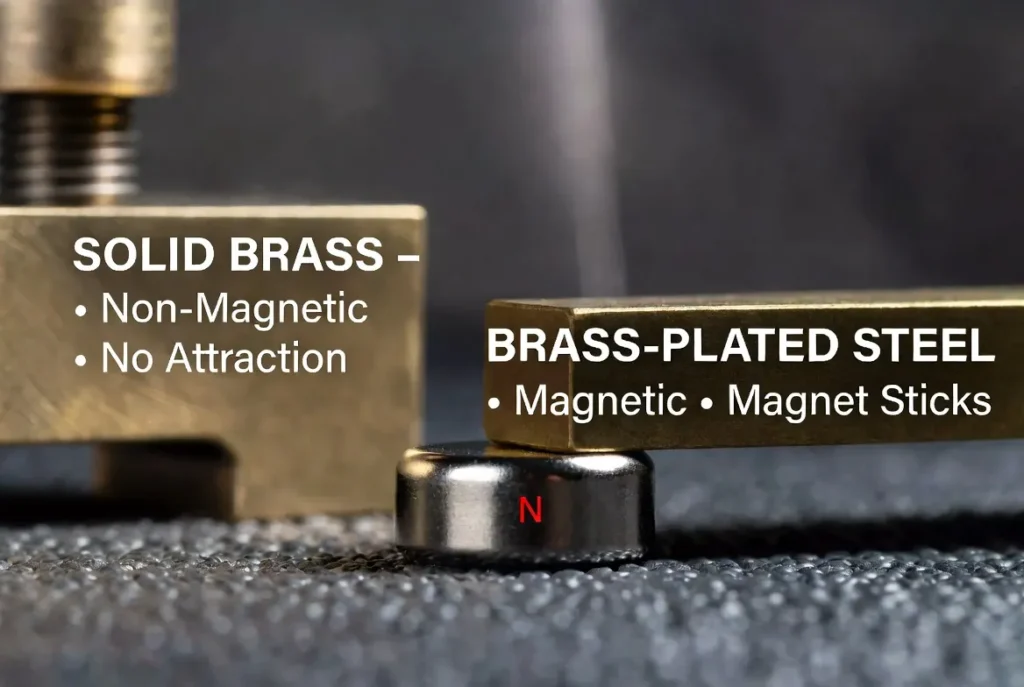
Practical Test: A strong neodymium magnet will not stick to solid brass. If it does stick, the part is likely brass-plated steel or contains iron impurities.
Can Brass Become Magnetic?
Under normal engineering and CNC machining conditions, brass cannot be permanently magnetized. Processes like machining, cold working, heat treatment, or welding do not introduce ferromagnetic properties.
In extremely strong external magnetic fields, brass may show temporary induced magnetism, but this disappears immediately when the field is removed. At cryogenic temperatures, brass exhibits clear diamagnetic behavior, but this has little relevance to room-temperature CNC applications.
Only very rare specialty brass alloys with added iron or nickel might show weak magnetic responses, but commercial grades used in CNC machining (such as C36000 free-machining brass) remain effectively non-magnetic.
Brass vs Bronze vs Copper: Magnetic Properties
| Material | Main Composition | Magnetic Behavior | Common CNC Applications |
| Brass | Copper + Zinc | Non-magnetic (diamagnetic) | Connectors, valves, fittings, gears |
| Bronze | Copper + Tin (±Al, P) | Non-magnetic | Bearings, marine fittings, bushings |
| Copper | Pure or high-purity Cu | Non-magnetic | Electrical contacts, heat sinks |
| Steel | Iron-based | Ferromagnetic | Structural parts (avoid in sensitive areas) |
Brass, bronze, and copper are all non-magnetic due to their copper base and lack of significant iron, nickel, or cobalt. This makes the copper alloy family highly preferred when magnetic fields could interfere with sensors, electronics, or compasses.
Practical Implications for CNC Machining
The non-magnetic nature of brass provides several advantages in CNC milling, turning, and drilling:
- No magnetic clamping interference with delicate or non-ferrous setups.
- Machining chips do not stick magnetically to the workpiece or machine table, simplifying cleanup.
- Ideal for precision electronic, aerospace sensor, and medical device components where even minor magnetic fields must be eliminated.
- Combined with brass’s outstanding machinability (especially C36000), it becomes a top choice for high-volume, tight-tolerance production.
Important Note: During machining, tool wear particles (from steel tools) may occasionally adhere to soft brass surfaces due to mechanical adhesion, not magnetism. Proper coolant and cleaning protocols easily solve this.
Common Applications of Non-Magnetic Brass in CNC
- Electronics & Electrical: Connectors, terminals, sockets, and RF/EMI shielding components.
- Marine & Plumbing: Fittings, valves, and hardware in saltwater environments.
- Medical & Scientific Instruments: Non-magnetic parts for MRI-compatible equipment and precision tools.
- Musical Instruments: Brass instruments benefit from both acoustic properties and non-magnetic behavior.
- Automotive & Aerospace: Sensor housings, gears, and precision fittings.
How to Test Brass Magnetism in the Shop
- Use a strong neodymium magnet — solid brass should show no attraction.
- Perform a scratch test on suspicious parts — if silver-colored metal appears underneath, it is likely plated steel.
- Check material certifications and specify “non-magnetic brass alloy” or common grades like C26000 or C36000.
- For critical applications, request permeability testing (relative permeability μr ≈ 1.0 for non-magnetic materials).
Conclusion
Standard brass is reliably non-magnetic for virtually all CNC machining and engineering applications. Its copper-zinc composition ensures it lacks the ferromagnetic elements found in iron, nickel, or cobalt-based metals. Combined with excellent machinability, corrosion resistance, and attractive appearance, brass remains a top material choice when magnetic interference must be avoided.
Ready to machine your next non-magnetic brass project? Our expert CNC team specializes in brass and other non-ferrous alloys. We provide material recommendations, DFM feedback, tight-tolerance machining, and fast turnaround. Contact us today for a free quote or technical consultation. Let’s deliver high-quality, non-magnetic components that perform exactly as designed.
FAQ
Is brass magnetic or non-magnetic? Standard brass is non-magnetic. It does not attract magnets or retain magnetic fields because it is composed of copper and zinc, both non-ferromagnetic metals.
Can brass become magnetic after machining or welding? No. Machining, cold working, heat treatment, or welding does not make brass magnetic.
Why does a magnet sometimes stick to my “brass” part? The part is likely brass-plated steel or contains magnetic impurities. A scratch test will usually reveal the steel core.
Is bronze magnetic? No. Like brass, bronze is a copper-based alloy and is non-magnetic.
Why is non-magnetic brass preferred in electronics and sensors? It prevents magnetic interference with sensitive components, reduces chip adhesion issues, and ensures reliable performance in connectors and shielding applications.
Which brass grade is best for CNC machining? C36000 (free-machining brass) is the most popular due to its excellent machinability while remaining fully non-magnetic.
Is brass safe for medical or MRI equipment? Yes. Its non-magnetic property makes it suitable for many MRI-compatible and medical device applications.