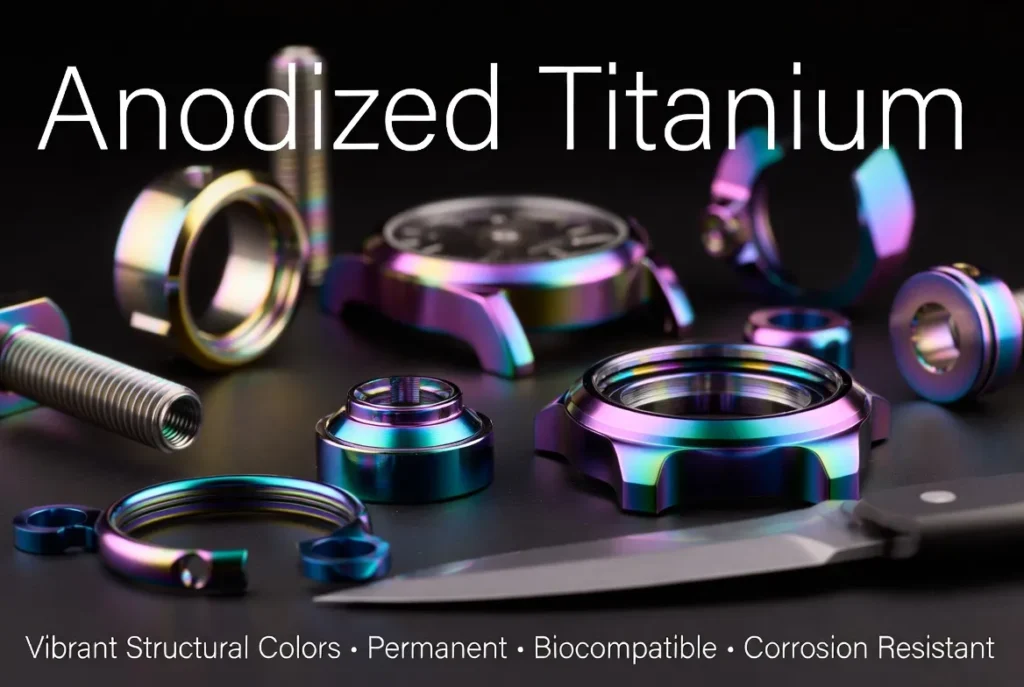
Anodized titanium has become one of the most sought-after surface finishes for precision CNC machined components. Unlike aluminum, which forms a thick oxide layer during anodizing, titanium anodizing creates a thin, transparent oxide film that produces stunning interference colors while significantly improving the metal’s performance and appearance.
From vibrant blues and purples on custom bike parts to biocompatible gold and bronze finishes on medical implants, anodized titanium combines functionality with striking aesthetics. This guide explains how titanium anodizing works, the available color range, its practical benefits, and why it’s increasingly chosen for high-end CNC machined parts.
What Is Anodized Titanium?
Anodizing titanium is an electrochemical process that grows a controlled oxide layer on the surface of the metal. This oxide film is extremely thin (typically 50–250 nanometers) and acts like a prism, producing beautiful interference colors depending on its thickness.
Unlike paint or dye, the colors in anodized titanium are structural — they result from light interference within the oxide layer itself. This makes the finish highly durable, scratch-resistant, and permanently bonded to the titanium substrate.
How the Titanium Anodizing Process Works
The process is relatively straightforward but requires precise control:
- Surface Preparation: The titanium parts are thoroughly cleaned and sometimes etched to ensure a uniform surface.
- Anodizing Bath: Parts are immersed in an electrolyte solution (commonly sulfuric acid or specialized titanium electrolytes).
- Electrochemical Reaction: A controlled voltage is applied. Higher voltage creates a thicker oxide layer, which shifts the interference color.
- Color Development: Colors appear progressively as voltage increases — from silver/gold at low voltage to deep blues, purples, and greens at higher voltages.
- Sealing (Optional): Some processes include a final sealing step to enhance durability and corrosion resistance.
The entire process is performed at room temperature and is highly repeatable when voltage, time, and electrolyte concentration are carefully managed.
Titanium Anodizing Colors
One of the most attractive features of anodized titanium is its wide range of vibrant, iridescent colors:
- Low voltage (10–30V): Silver, gold, bronze, and light purple
- Medium voltage (40–70V): Blue, teal, and violet
- High voltage (80–120V+): Deep purple, green, pink, and rainbow effects
These colors are not applied pigments but result from light interference, so they remain stable under UV light and do not fade like dyed coatings. Different base titanium alloys (Grade 2, Grade 5/Ti-6Al-4V, etc.) may produce slightly different color tones.
Key Benefits of Anodized Titanium
Anodizing titanium provides several important advantages for CNC machined parts:
- Enhanced Corrosion Resistance: The thickened oxide layer offers superior protection in harsh environments, including saltwater and bodily fluids.
- Improved Wear Resistance: The ceramic-like oxide surface is significantly harder than raw titanium.
- Biocompatibility: Anodized titanium is widely used in medical implants and surgical instruments because the stable oxide layer reduces ion release.
- Aesthetic Appeal: The vibrant, permanent colors create a premium look without additional coatings.
- Thermal Stability: Colors remain stable at much higher temperatures than painted or PVD-coated surfaces.
- Easy Identification: Different colors can be used to code parts by size, material grade, or function.
Common Applications for Anodized Titanium CNC Parts
Anodized titanium is popular across many high-performance industries:
- Aerospace & Defense: Lightweight fasteners, brackets, and structural components
- Medical & Dental: Implants, surgical tools, dental abutments, and instruments
- Automotive & Motorsports: Custom bolts, exhaust components, suspension parts, and decorative trim
- Consumer Electronics & Watches: Premium cases, buttons, and frames
- Outdoor & Tactical Gear: Knife scales, firearm components, camping equipment, and bicycle parts
- Jewelry & Fashion: High-end rings, pendants, and accessories
Considerations for CNC Machined Titanium Parts
When planning to anodize titanium components, keep these points in mind:
- Surface finish before anodizing greatly affects final color uniformity — polished or finely machined surfaces yield the brightest colors.
- Tight tolerances must account for the slight growth of the oxide layer (usually 0.0001–0.0005 inches).
- Grade 5 (Ti-6Al-4V) is the most commonly anodized alloy for structural parts, while commercially pure Grade 2 is often used for medical applications.
- Masking techniques can create two-tone or multi-color designs on a single part.
Working with an experienced CNC machining and anodizing partner ensures consistent color, proper adhesion, and maintained dimensional accuracy.
Ready to anodize your titanium CNC parts? Our team specializes in precision titanium machining and professional anodizing services. We help customers select the right titanium grade, achieve exact color specifications, and deliver durable, beautiful components for medical, aerospace, automotive, and consumer applications. Contact us today for expert guidance, color samples, or a free quote on your next anodized titanium project.
FAQ
What is the difference between anodized titanium and anodized aluminum?
Titanium anodizing produces thin interference colors through voltage control, while aluminum anodizing creates a much thicker porous layer that is usually dyed. Titanium colors are more stable and scratch-resistant.
Does anodizing titanium make it stronger?
It improves surface hardness and wear resistance but does not significantly increase the bulk strength of the titanium.
Are anodized titanium colors permanent?
Yes. The colors are structural (created by light interference) and do not fade under normal use or UV exposure.
Can all titanium alloys be anodized?
Most can, but Grade 5 (Ti-6Al-4V) and commercially pure titanium (Grade 2 & 4) are the most commonly anodized alloys with the best color results.
Is anodized titanium safe for medical implants?
Yes. Anodized titanium is highly biocompatible and widely used in medical and dental implants because the stable oxide layer minimizes ion release.
How long does the anodizing process take?
For most small to medium CNC parts, the actual anodizing step takes 30–90 minutes, depending on desired color and batch size. Full turnaround including preparation is usually 1–3 days.