

Titanium is one of the most sought-after materials in high-performance industries due to its exceptional strength-to-weight ratio, excellent corrosion resistance, and biocompatibility. However, titanium machining is notoriously difficult and demands specialized knowledge, tooling, and techniques to achieve efficient production and high-quality surface finishes.
From aerospace structural components to medical implants and racing parts, successful titanium machining requires understanding its unique material behavior and applying the right strategies. This guide covers the main challenges, proven best practices, recommended parameters, and practical tips to help you machine titanium effectively on CNC equipment.
Why Titanium Is Difficult to Machine
Titanium presents several unique machining challenges:
- Low Thermal Conductivity: Heat generated during cutting stays concentrated at the tool tip instead of dissipating through the workpiece, leading to rapid tool wear and potential work hardening.
- High Strength and Toughness: Titanium maintains its strength even at elevated temperatures, making it resistant to cutting.
- Work Hardening: The material tends to harden quickly during machining, increasing cutting forces and tool wear.
- Chemical Reactivity: At high temperatures, titanium can react with oxygen and nitrogen in the air, forming a hard, abrasive scale.
- Spring-Back Effect: Titanium has significant elasticity, which can cause dimensional inaccuracies if not properly managed.
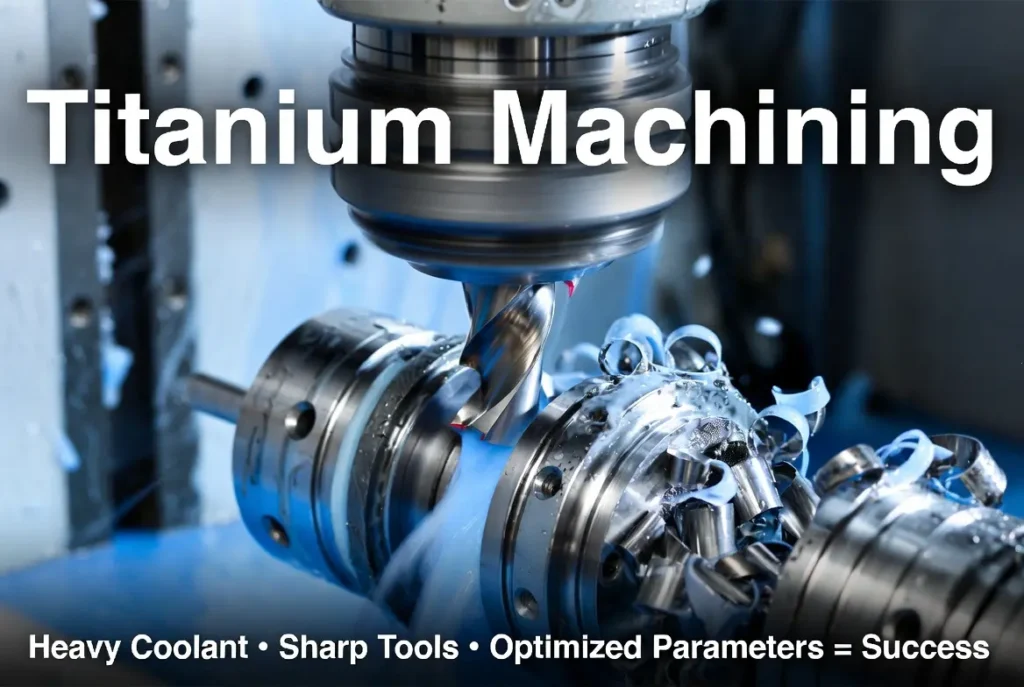
These factors make titanium significantly more challenging to machine than aluminum or mild steel, often requiring slower speeds, specialized tools, and generous coolant.
Best Practices for Successful Titanium CNC Machining
To overcome titanium’s challenges, follow these proven strategies:
- Tool SelectionUse high-quality carbide tools with sharp edges and coatings specifically designed for titanium (such as TiAlN or AlTiN). Positive rake angles and polished flutes help reduce built-up edge and heat generation. Ceramic tools can be effective for roughing in certain conditions.
- Cutting Parameters
- Lower cutting speeds than steel or aluminum (typically 30–60 m/min for milling Grade 5 titanium)
- Higher feed rates to maintain chip thickness and reduce heat buildup
- Moderate depth of cut to avoid excessive tool load
- Use trochoidal or dynamic milling strategies when possible to keep constant tool engagement
- Coolant StrategyGenerous, high-pressure coolant is essential. Through-tool coolant (delivered directly to the cutting zone) is highly recommended. Some shops use specialized high-pressure coolant systems (70–100 bar) to improve chip evacuation and tool life.
- Rigid SetupMinimize vibration with sturdy workholding, short tool overhangs, and high-rigidity machine tools. Even small vibrations can accelerate tool wear when machining titanium.
Pro Tip: Always machine titanium in its annealed condition whenever possible. Heat-treated titanium is significantly harder and more difficult to cut.
Titanium Grades and Their Machinability
Different titanium grades behave differently during machining:
- Grade 2 (Commercially Pure): Easier to machine, good for corrosion-resistant but lower-strength parts.
- Grade 5 (Ti-6Al-4V): Most common aerospace and medical grade. More difficult to machine due to higher strength but offers the best strength-to-weight performance.
- Grade 23 (Ti-6Al-4V ELI): Medical grade with slightly better machinability and biocompatibility than standard Grade 5.
Grade 5 accounts for the majority of CNC titanium machining work.
Common Applications of CNC Machined Titanium Parts
Titanium is chosen when performance justifies the higher material and machining cost:
- Aerospace: Structural brackets, landing gear components, and engine parts
- Medical: Implants, surgical instruments, and prosthetics
- Automotive & Motorsports: Connecting rods, valves, and suspension components
- Marine: Propeller shafts and high-corrosion fittings
- Consumer: High-end watches, bicycle frames, and outdoor gear
Cost and Efficiency Considerations
Titanium machining is expensive due to slow cutting speeds, high tool consumption, and long cycle times. However, the material’s light weight and durability can reduce overall system costs in weight-sensitive applications.
To control costs:
- Optimize tool paths using high-efficiency strategies
- Use the largest possible tool diameters
- Implement tool life monitoring
- Consider near-net-shape roughing before final CNC operations
Ready to machine your titanium components successfully? Our CNC team has extensive experience with titanium machining, including Grade 2, Grade 5, and Grade 23. We provide expert DFM feedback, optimized machining strategies, and reliable production of complex titanium parts. Contact us today for a free consultation or quote.
FAQ
Why is titanium so difficult to machine?
Its low thermal conductivity causes heat to concentrate at the tool tip, combined with high strength and work-hardening tendencies.
What is the best cutting speed for titanium?
For Grade 5 titanium, typical milling speeds range from 30–60 m/min, significantly slower than aluminum or steel.
Should I use coolant when machining titanium?
Yes. High-pressure through-tool coolant is highly recommended to reduce heat, improve chip evacuation, and extend tool life.
Can titanium be machined on a standard 3-axis CNC?
Yes, but 4-axis or 5-axis machines are often preferred for complex geometries to reduce setups and improve accuracy.
Is Grade 5 titanium harder to machine than Grade 2?
Yes. Grade 5 (Ti-6Al-4V) is stronger and more difficult to cut than commercially pure Grade 2 titanium.
How can I improve tool life when machining titanium?
Use sharp, coated carbide tools, maintain high feed rates, apply generous high-pressure coolant, and minimize tool overhang.