

Zinc plate, in the context of CNC-machined components, refers to an electrodeposited zinc coating applied to iron or steel parts. The coating provides sacrificial corrosion protection: zinc corrodes preferentially and thereby shields the underlying steel. The process is controlled, relatively thin, and suitable for precision parts where dimensional change must remain limited.
It is distinct from hot-dip galvanizing. Zinc plate is an electrochemical deposit applied after machining; galvanizing is a thicker metallurgical coating formed by immersion in molten zinc.
What Zinc Plate Means in CNC Work
After a steel part is CNC milled or turned to final geometry, it is cleaned and placed in an electrolytic bath containing zinc ions. The part becomes the cathode. Applied current drives zinc ions onto the surface, building a metallic zinc layer. The deposit is then usually treated with a chromate or passivate conversion coating that adds color and slows the formation of white zinc corrosion products.
The governing industrial specification is ASTM B633, which defines thickness classes and service conditions for electrodeposited zinc on iron and steel. Thickness is measured in micrometers and is specified as a minimum average or local value depending on the drawing callout.
Because the coating is thin and controllable, zinc plate is the common choice for CNC parts that must retain thread fit, press-fit diameters, or close mating surfaces after finishing.
How Zinc Plating Works
The cleaned steel part is immersed in an aqueous zinc electrolyte (alkaline non-cyanide or acid chloride systems are typical). Direct current flows between zinc anodes and the part. Zinc ions reduce at the cathode surface and deposit as metallic zinc. Current density, bath chemistry, temperature, and time determine thickness and uniformity.
After deposition, the part is rinsed and usually receives a conversion coating. The conversion layer reacts with the zinc surface to form a thin chromate or trivalent passivate film. This film improves corrosion resistance and supplies the characteristic clear, yellow, black, or olive appearance.
On high-strength steels the process can introduce hydrogen. Atomic hydrogen may enter the lattice during cleaning or plating and reduce ductility. Parts above a critical hardness or strength level therefore require a post-plating bake to drive out hydrogen and reduce the risk of delayed cracking.
Thickness and ASTM B633 Classes
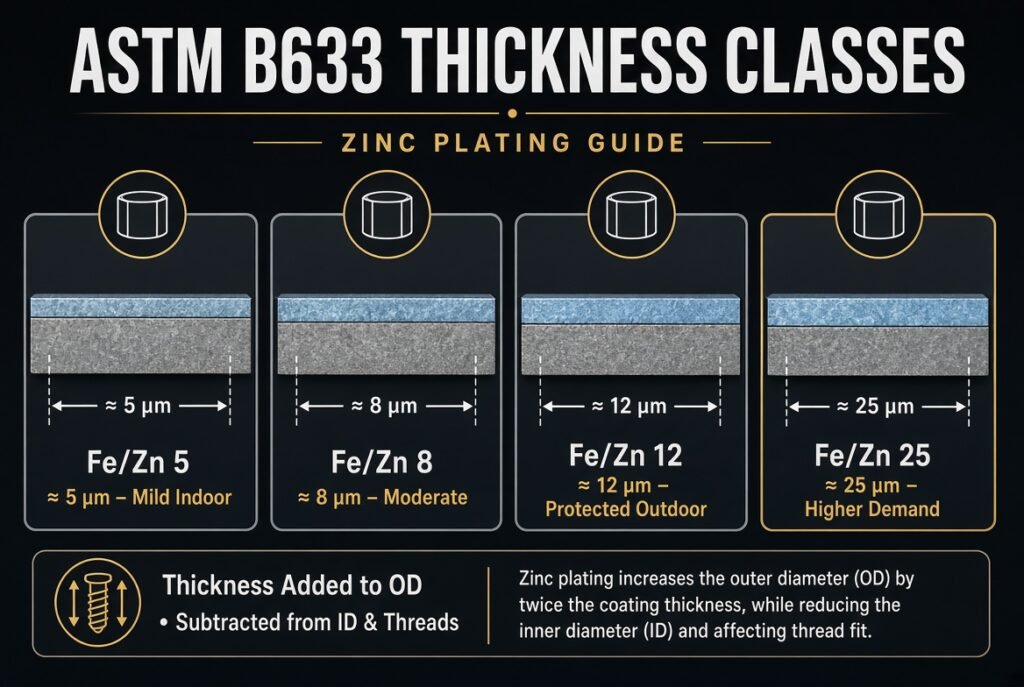
ASTM B633 groups coatings by service condition and minimum thickness. Common industrial callouts are:
- Fe/Zn 5 (approximately 5 µm) — mild indoor exposure
- Fe/Zn 8 (approximately 8 µm) — moderate indoor or light industrial use
- Fe/Zn 12 (approximately 12 µm) — more demanding indoor or protected outdoor service
- Fe/Zn 25 (approximately 25 µm) — higher corrosion demand where the added thickness is still acceptable
Thickness is added to external surfaces and subtracted from internal diameters and thread flanks. On a precision thread the effective pitch diameter change can be roughly twice the plating thickness because both flanks receive deposit. Drawings must state whether dimensions apply before or after plating and which surfaces require masking.
Chromate and Passivate Finishes
The zinc deposit itself is reactive and forms white corrosion products quickly if left untreated. A conversion coating is therefore standard.
Clear (blue-bright) trivalent passivate produces a transparent to slightly bluish finish and is widely used where RoHS compliance and a clean appearance are required. Yellow (iridescent) passivate traditionally offered higher corrosion resistance; modern trivalent yellow systems approach that performance while remaining RoHS-compliant. Black and olive-drab finishes serve identification or low-reflectivity needs. Phosphate conversion coatings are sometimes specified when the zinc surface will later receive paint.
Hexavalent chromates are still referenced in older specifications but are restricted in many markets. Current practice favors trivalent chemistry unless a specific legacy requirement forces otherwise.
Advantages
Zinc plate is cost-effective for steel components that need moderate corrosion protection without the dimensional penalty of thicker coatings. The sacrificial mechanism continues to protect the steel even if the coating is scratched, provided the zinc remains electrically continuous. Thickness can be held within a few micrometers, so most CNC tolerances remain usable. Appearance is uniform and can be selected by passivate type. The process works on complex machined geometry when racking or barrel methods are chosen appropriately.
Limitations and Design Considerations
Zinc is soft. The coating offers little abrasion or wear resistance and is not a substitute for hard chrome, electroless nickel, or other wear surfaces. Corrosion life is limited in continuous outdoor, marine, or chemically aggressive environments; thicker systems or zinc-nickel alloys are usually required. Coverage is not perfectly uniform: high-current-density areas (edges, corners) plate thicker, while deep recesses and blind holes plate thinner. Threads and close fits must be designed with plating allowance or masked. High-strength steels carry hydrogen-embrittlement risk and need controlled baking. The coating does not hide machining marks, pits, or porosity; surface preparation before plating determines final appearance.
Zinc Plate vs Hot-Dip Galvanizing
Hot-dip galvanizing immerses the part in molten zinc and produces a thick, metallurgically bonded coating typically 50 µm or more. Corrosion resistance is higher and the coating is robust outdoors, but the thickness and roughness make it unsuitable for most precision CNC dimensions, fine threads, and close-tolerance fits. Zinc plate remains thinner, smoother, and dimensionally predictable, which is why it is preferred for machined components that must assemble after finishing.
Applications for CNC-Machined Parts
Zinc plate is used on steel brackets, housings, flanges, fasteners, shafts, and general hardware that operate in indoor or moderately corrosive environments. It appears in industrial machinery, automotive under-hood or chassis components (where specified), electrical enclosures, and any steel part that needs low-cost sacrificial protection without the bulk of galvanizing. Color variants serve both corrosion and visual identification functions.
Practical Tips for CNC Parts
Specify thickness, passivate type, and applicable standard (commonly ASTM B633) on the drawing. State whether dimensions are before or after plating. Mask critical datums, bearing diameters, and precision threads when plating thickness would violate fit. For high-strength steel, require the bake cycle and document the strength or hardness limit. Clean the part thoroughly after machining; residual oil or coolant produces skip plating or adhesion failures. Request thickness verification and, when needed, salt-spray results on the actual geometry rather than flat test panels. Consider zinc-nickel or alternative coatings when the service environment exceeds the capability of conventional zinc plate.
Selection Guidance
Choose zinc plate when the part is steel, the corrosion demand is moderate, dimensional change must stay small, and cost is a factor. Move to thicker galvanizing or zinc-nickel when outdoor or aggressive exposure dominates. Use electroless nickel or other systems when wear resistance or higher corrosion performance is required and the extra cost is justified. Always confirm the plating process capability against the actual part geometry, material strength, and required fits before releasing the drawing.