

Aluminum bending is a fundamental process in sheet metal fabrication and CNC manufacturing. It involves applying controlled mechanical force to transform flat aluminum sheets, plates, tubes, pipes, or profiles into complex shapes such as brackets, enclosures, frames, and architectural components.
Thanks to aluminum’s excellent strength-to-weight ratio, corrosion resistance, and formability, it is widely used across industries including aerospace, automotive, marine, electronics, construction, and medical equipment. However, successful aluminum bending requires careful consideration of material properties, alloy selection, temper condition, bend radius, and the appropriate forming technique.
This in-depth guide covers the essential factors that influence aluminum bendability, recommended alloys, temper designations, proven bending methods, strategies to prevent cracking and springback, and practical tips for achieving high-quality, repeatable results in precision fabrication.
Factors Affecting the Aluminum Bending Process
Several material and process variables determine how well aluminum performs during bending:
- Formability: Aluminum alloys generally offer good formability, allowing them to be bent without cracking. However, formability varies significantly between alloys and tempers. Softer alloys bend more easily, while high-strength alloys require more careful handling.
- Elongation: This measures how much the material can stretch before fracture. Alloys with higher elongation percentages are easier to bend and less prone to cracking.
- Material Thickness and Bend Radius: Thicker aluminum sheets demand greater force and larger minimum bend radii to avoid cracks. Conversely, thinner sheets with larger bend radii are easier to form. A general rule is to maintain a bend radius at least equal to the material thickness (1T) for most alloys, though some may require 2T–3T or more.
- Grain Direction: Bending perpendicular to the grain direction usually yields better results and reduces the risk of cracking compared to bending parallel to the grain.
Understanding these factors helps fabricators select the right parameters and minimize defects such as cracking, wrinkling, or excessive springback.
Best Aluminum Alloys for Bending
Not all aluminum alloys bend equally well. Here are the most commonly used alloys for bending applications:
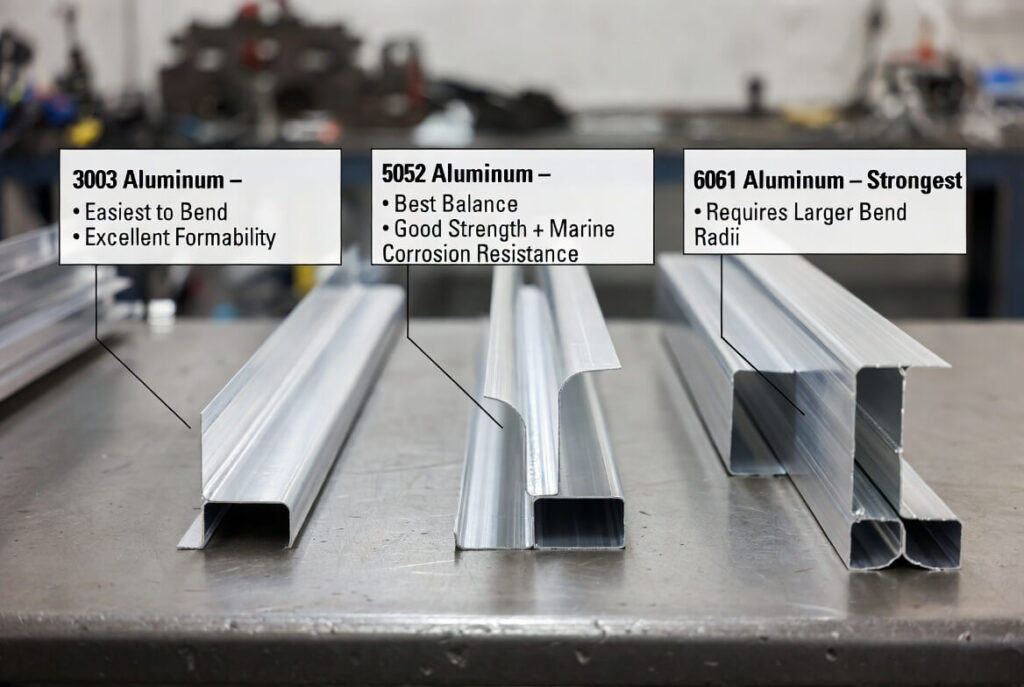
3003 Series One of the most popular and easiest-to-bend alloys, containing manganese as the primary alloying element. It offers excellent formability and can often be bent without heating. Ideal for roofing, sidings, chemical equipment, storage tanks, and general sheet metal work.
5052 Series Stronger than 3003 due to higher magnesium content. It provides good rigidity after bending while maintaining solid formability and superior corrosion resistance, especially in marine or salty environments. Common applications include marine hardware, medical equipment, hydraulic tubes, and signage.
6061 Series A high-strength alloy with silicon and magnesium, widely used in structural applications. It is more difficult to bend than 3003 or 5052 due to its rigidity, often requiring larger bend radii or specialized techniques. Frequently used in aerospace, automotive, and structural components.
For even higher strength needs (such as 2024 or 7075), bending becomes significantly more challenging and may require annealing or specialized tooling.
Temper Selection for Aluminum Bending
Temper designation greatly affects bendability:
- O (Annealed): Softest and most formable temper. Ideal for tight bends but may require additional processing for strength.
- H (Strain-Hardened): Offers a balance between formability and strength. H14 or H32 tempers are common for bending.
- T (Heat-Treated): Provides maximum strength but is harder to bend and more prone to cracking (e.g., T6 temper in 6061).
- F (As-Fabricated): Variable properties; not usually preferred for precision bending.
Softer tempers (O or H) reduce springback and cracking risk, while harder tempers may need over-bending to compensate for elastic recovery.
How to Prevent Cracking and Springback in Aluminum Bending
Aluminum bending is both an art and a science. While the material offers excellent strength-to-weight ratio and corrosion resistance, it can be surprisingly temperamental during forming. Two of the most persistent challenges fabricators face are cracking and springback — issues that can turn a perfectly planned part into costly scrap if not properly managed.
Preventing Cracking: Keeping Aluminum Happy Under Stress
Cracking occurs when the outer surface of the bend is stretched beyond its limits. To avoid these frustrating fractures, consider the following proven strategies:
- Choose the Right Alloy and Temper: Not all aluminum behaves the same. Opt for alloys and tempers with higher elongation percentages (such as 5052-H32 or 6061-T4), which are more forgiving and can stretch further before cracking. Think of it as selecting a more flexible dancer rather than a rigid performer.
- Respect the Minimum Bend Radius: One of the golden rules in aluminum bending is to never go too tight. Always follow the recommended minimum bend radius for your specific alloy and sheet thickness. Using a radius that is too small is like asking the material to fold sharply without tearing — it rarely ends well.
- Apply High-Quality Lubrication: Proper lubrication significantly reduces friction between the tooling and the aluminum surface. This not only lowers the required bending force but also minimizes surface damage and the risk of micro-cracks.
- Consider Controlled Pre-Heating: For challenging alloys or particularly tight bends, gentle pre-heating can dramatically improve formability. The key is precise temperature control — too hot, and you risk altering the material properties; too cool, and the benefit disappears.
- Ensure Perfect Clamping and Alignment: Even stress distribution is critical. Proper clamping and precise alignment prevent localized stress concentrations that often lead to cracks along the bend line.
- Use Appropriate Tooling and Equipment: Match your tooling (punch, die, and press brake) to the material thickness and alloy type. High-quality, well-maintained equipment makes a noticeable difference in achieving clean, crack-free bends.
Minimizing Springback: Outsmarting Aluminum’s Elastic Memory
Springback is aluminum’s natural tendency to partially return to its original shape after bending, caused by its elastic recovery. This “memory effect” can throw off your final angles if not anticipated. Here’s how to keep it under control:
- Slightly Over-Bend: The most straightforward compensation technique is to intentionally over-bend the material by a calculated amount. This allows the part to spring back exactly to the desired angle.
- Leverage CNC Precision: Modern CNC press brakes with real-time angle monitoring and adaptive control systems offer exceptional accuracy. They can automatically adjust for springback during the bending process, dramatically reducing trial-and-error.
- Select Softer Tempers When Possible: Lower-strength tempers generally exhibit less springback. When design specifications allow, choosing a more ductile temper can simplify the entire bending process.
- Always Perform Test Bends: Before committing to a full production run, run several test bends on scrap material of the same alloy, thickness, and grain direction. This calibration step is invaluable for fine-tuning your machine settings and predicting actual springback behavior.
Common Aluminum Bending Methods: Choosing the Right Tool for the Job
Different bending methods excel in different scenarios, depending on part geometry, material thickness, production volume, and required precision. Understanding their strengths and limitations helps you select the most efficient approach.
Press Brake Bending This remains the most versatile and widely used method in sheet metal fabrication. The aluminum sheet is positioned between a punch and a die, and the punch drives the material into the die to form precise angles. It shines when producing sharp bends, complex profiles, and parts that demand high repeatability — making it a favorite for precision CNC aluminum components.
Roll Bending Imagine gently coaxing a flat sheet into graceful curves using a series of powerful rolls. Roll bending is ideal for creating large-radius arcs, full cylinders, and conical shapes. It performs particularly well with thicker aluminum plates and is commonly used for architectural elements and structural components.
Rotary Draw Bending Perfect for tubes and pipes, this method uses a rotating die and an internal mandrel to support the tube wall during bending. It delivers tight-radius bends with minimal distortion and ovality, making it essential for high-quality tubular aluminum structures in industries like automotive, aerospace, and furniture.
Ram (Push) Bending A simple and cost-effective technique where a ram pushes the material against a fixed die or fixture. While excellent for straightforward tight bends, it offers lower precision and is better suited for low-volume or prototype work rather than complex, high-tolerance production.
Three-Roller Bending This method employs three adjustable rolls to gradually form large-radius curves. It is frequently chosen for architectural panels, storage tanks, and large structural curves where smooth, consistent radii are required.
Compression Bending Similar in principle to press brake bending but often applied to specific extruded profiles. The material is compressed between tooling to achieve the desired shape.
Each bending method comes with its own balance of precision, setup cost, speed, and suitability for part size or complexity. Today’s advanced CNC press brakes and rotary draw bending machines represent the pinnacle of accuracy and repeatability, enabling fabricators to achieve tight tolerances and superior surface quality in aluminum parts.
Practical Tips for Successful Aluminum Bending
- Always perform test bends on sample material to verify settings.
- Maintain clean surfaces — remove oils, oxides, or residues before bending.
- Account for material grain direction in design.
- For high-precision CNC parts, combine bending with laser cutting or CNC machining for tight tolerances.
- Consider post-bend operations such as heat treatment or stress relieving if needed.
- For very tight radii or high-strength alloys, annealing may be required prior to bending.
Conclusion
If you need professional aluminum bending, sheet metal fabrication, or complete CNC aluminum component production — from prototypes to high-volume orders — our experienced team delivers precise, high-quality results. We specialize in press brake bending, rotary draw bending, and complex forming across 3003, 5052, 6061, and other alloys, with full in-house capabilities for cutting, bending, welding, and finishing.
Send your drawings or 3D files today for a free manufacturability review, DFM feedback, and competitive quote. Whether you require tight-tolerance bends, large-radius curves, or corrosion-resistant marine-grade parts, we ensure consistent quality, fast lead times, and cost-effective solutions.
FAQ
Q1: Which aluminum alloy is easiest to bend?
A: 3003 series is generally the easiest due to its excellent formability. 5052 offers a good balance of strength and bendability, while 6061 is stronger but more challenging to bend.
Q2: What is the minimum bend radius for aluminum?
A: It depends on alloy, temper, and thickness. A common starting point is 1T (one times material thickness), but harder alloys or tempers may require 2T–4T or more to avoid cracking.
Q3: How can I prevent cracking when bending aluminum?
A: Use proper bend radii, suitable alloys and tempers, lubrication, correct tooling, and sometimes pre-heating. Always test on scrap material first.
Q4: What is springback in aluminum bending?
A: Springback is the elastic recovery of the material after bending, causing the final angle to open slightly. It can be compensated by over-bending or using CNC-controlled equipment.
Q5: Is press brake or rotary draw bending better for aluminum tubes?
A: Rotary draw bending with a mandrel is usually preferred for tubes as it maintains roundness and prevents collapse on tight radii.
Q6: Can thick aluminum plates be bent?
A: Yes, using roll bending, three-roller bending, or heavy-duty press brakes. Thicker material requires more force and larger radii.