
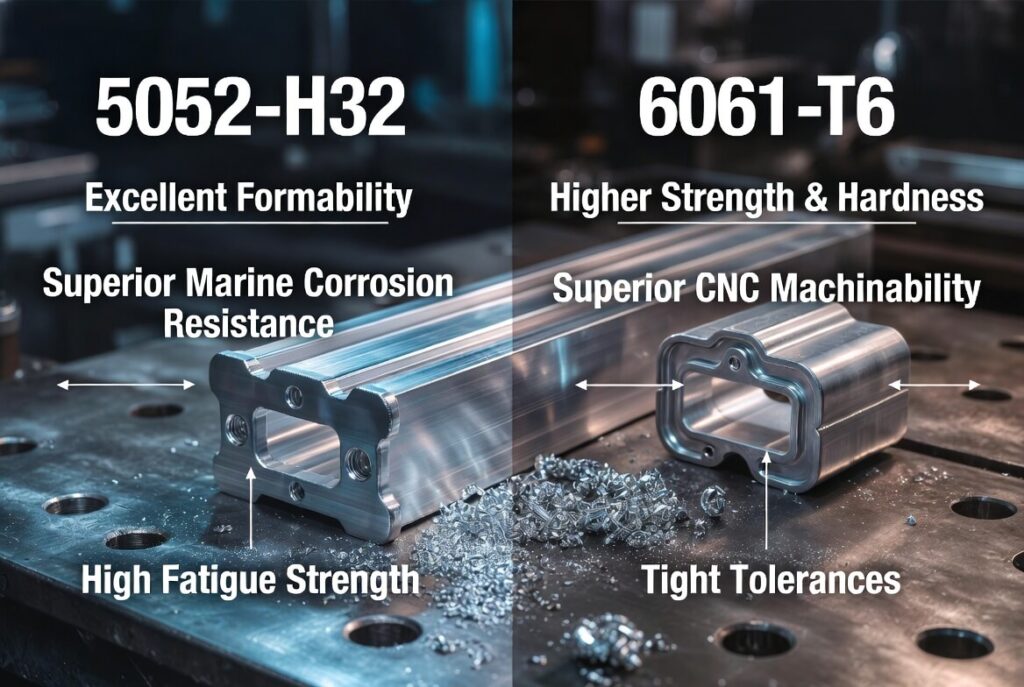
When selecting materials for CNC machined components, aluminum alloys stand out for their excellent strength-to-weight ratio, corrosion resistance, and versatility. Two of the most frequently compared options are 5052-H32 and 6061-T6. Engineers and manufacturers often debate which one delivers better results, especially in precision CNC operations where tolerances, surface finish, tool life, and part performance matter.
Both alloys are lightweight, anodizable, and widely available, but they differ significantly in mechanical properties, workability, and ideal use cases. Choosing incorrectly can lead to higher costs, poor machinability, cracking during processing, or premature part failure. This guide breaks down their compositions, key properties, machining behavior, and practical applications to help you make an informed decision for your next CNC project.
Understanding the Alloys: Composition and Temper
5052-H32 belongs to the 5xxx series, primarily alloyed with magnesium (about 2.2–2.8%) and a small amount of chromium. It is a non-heat-treatable alloy strengthened through strain hardening (cold working). The H32 temper indicates it has been strain-hardened and stabilized, offering a good balance of strength and ductility.
6061-T6 is from the 6xxx series, with magnesium (0.8–1.2%) and silicon (0.4–0.8%) as main alloying elements. It is heat-treatable: the T6 temper means it has been solution heat-treated and artificially aged to achieve peak strength. This makes it one of the most popular “structural” aluminum alloys.
Both provide good corrosion resistance, but 5052-H32 excels in harsh environments like marine or saltwater exposure due to its magnesium content.
Key Mechanical Properties Comparison
Here’s a clear breakdown of the most important properties for CNC applications:
- Ultimate Tensile Strength: 5052-H32 ≈ 33,000 psi (228 MPa); 6061-T6 ≈ 45,000 psi (310 MPa).
- Yield Strength: 5052-H32 ≈ 28,000 psi (193 MPa); 6061-T6 ≈ 40,000 psi (276 MPa).
- Fatigue Strength: 5052-H32 is notably higher, making it more resistant to repeated stress cycles.
- Hardness: 6061-T6 is harder, which contributes to better wear resistance in structural parts.
- Density: Both are very similar (around 2.68–2.70 g/cm³), keeping parts lightweight.
Pro Tip: For load-bearing or structural CNC parts, 6061-T6’s higher strength often wins. For components subject to vibration or cyclic loading, 5052-H32’s superior fatigue performance can extend service life.
Machinability for CNC Operations
This is where the biggest practical difference appears in CNC machining:
- 6061-T6offers excellent machinability. It produces clean chips, holds tight tolerances well, and delivers superior surface finishes straight off the machine. It is less “gummy,” reducing built-up edge on tools and allowing higher speeds and feeds in milling, turning, drilling, and tapping. This makes it the preferred choice for complex, precision CNC parts like aerospace fittings, automotive components, or hydraulic manifolds.
- 5052-H32has only fair machinability. Its softer, more ductile nature can cause it to be “gummier,” leading to longer, stringy chips, potential tool buildup, and more burrs. It often requires specialized tooling, slower parameters, or better coolant strategies to achieve good results. However, it still machines adequately for simpler parts.
In CNC environments, 6061-T6 generally allows faster cycle times, lower tool wear for high-volume runs, and easier achievement of tight tolerances (±0.001″ or better).
Important Note: If your part involves significant sheet forming or bending alongside machining, 5052-H32 performs much better without cracking.
Formability, Weldability, and Workability
- Formability: 5052-H32 shines with excellent formabilityand bendability. It can be easily cold-worked into complex shapes without cracking, making it ideal for sheet metal fabrication that may later involve light CNC operations.
- Weldability: 5052-H32 has excellent weldabilitywith minimal distortion. 6061-T6 offers good weldability, but welds can reduce strength in the heat-affected zone, and it is more prone to cracking during bending after welding.
- Extrudability: 6061-T6 excels here and is commonly available in extruded shapes, beneficial for structural profiles that require subsequent CNC machining.
Corrosion Resistance and Surface Finish
Both alloys resist corrosion well and can be anodized for enhanced protection and aesthetics. 5052-H32 provides superior performance in marine, chemical, or saltwater environments. 6061-T6 delivers reliable general-purpose corrosion resistance suitable for most indoor or mild outdoor applications. Surface quality after machining tends to be smoother and more consistent with 6061-T6.
Common Applications in CNC Machining and Fabrication
Choose 5052-H32 when your project needs:
- Excellent corrosion resistance (e.g., marine hardware, boat components, fuel tanks, enclosures)
- High formability and fatigue resistance (e.g., brackets, panels, or parts with repeated flexing)
- Sheet or plate components that may combine forming and light machining
Choose 6061-T6 when your project needs:
- Higher strength and structural integrity (e.g., aerospace fittings, bicycle frames, hydraulic piping, machine frames)
- Superior CNC machinability and tight tolerances (e.g., precision housings, manifolds, fixtures)
- Extruded profiles that require extensive milling or turning
Many manufacturers use 5052-H32 for sheet-metal-heavy parts and switch to 6061-T6 for purely machined or load-critical components.
Cost Considerations
5052-H32 is often slightly more affordable for sheet and plate forms, though its “gummier” nature can increase labor or tooling costs during machining. 6061-T6 may carry a higher material price but can reduce overall machining time and tool wear, potentially lowering total part cost in high-precision CNC runs. Always evaluate the full manufacturing process when comparing quotes.
How to Decide: A Practical Selection Guide
- Prioritize strength and precision machining?→ Go with 6061-T6.
- Need superior corrosion resistance or formability?→ Choose 5052-H32.
- Cyclic loading or vibration?→ Favor 5052-H32 for its fatigue strength.
- Tight tolerances and best surface finish?→ 6061-T6 is usually the winner.
- Budget and weld-heavy assembly?→ Evaluate 5052-H32 first.
In many CNC shops, 6061-T6 serves as the default “workhorse” alloy, while 5052-H32 is specified when its unique advantages align with the part’s functional requirements.
Conclusion
There is no universal “best” aluminum alloy — only the best fit for your specific CNC part. 6061-T6 generally dominates in pure machining scenarios thanks to its strength, hardness, and excellent chip control. 5052-H32 excels when formability, fatigue resistance, or marine-grade corrosion protection is critical.
Careful material selection early in the design phase can improve part performance, reduce costs, and avoid production headaches. Consult with your CNC machining partner to review drawings, tolerances, and environmental demands before finalizing the alloy.
Ready to optimize your CNC aluminum parts? Our team specializes in precision CNC machining with both 5052-H32 and 6061-T6 alloys. Whether you need expert material recommendations, DFM feedback, tight-tolerance prototypes, or high-volume production, we’re here to help. Contact us today for a free consultation, quote, or machining advice tailored to your project. Let’s turn your design into high-quality, reliable components efficiently.
FAQ
What is the main difference between 5052-H32 and 6061-T6 aluminum?
5052-H32 is non-heat-treatable with excellent formability, fatigue strength, and corrosion resistance (especially in marine settings). 6061-T6 is heat-treatable, offering higher tensile and yield strength plus superior machinability for CNC work.
Which alloy is better for CNC machining?
6061-T6 is generally better for CNC machining due to its excellent machinability, cleaner chips, and ability to hold tight tolerances with good surface finish.
Is 5052-H32 easier to weld than 6061-T6?
Yes, 5052-H32 has excellent weldability with less risk of cracking, while 6061-T6 has good weldability but may lose some strength in the weld zone.
Can both alloys be anodized?
Yes, both 5052-H32 and 6061-T6 respond well to anodizing for improved corrosion resistance and appearance.
Which alloy is stronger?
6061-T6 has higher ultimate tensile strength (≈45,000 psi) and yield strength compared to 5052-H32 (≈33,000 psi tensile).
When should I choose 5052-H32 over 6061-T6?
Choose 5052-H32 for applications requiring superior formability, higher fatigue resistance, or excellent corrosion resistance in harsh environments like marine or chemical exposure.
Does 5052-H32 machine poorly in CNC?
It has fair machinability and can be gummy, requiring adjusted parameters and tooling. It works well for less complex parts but is not ideal for high-precision, high-volume machining compared to 6061-T6.
Are there cost differences between the two?
Material costs vary, but 6061-T6 can sometimes be more economical overall in CNC production due to faster machining times and lower tool wear.