
Electropolishing for Custom Parts
Electropolishing delivers a smooth, bright, and corrosion-resistant surface by precisely removing a thin layer of metal. Ideal for stainless steel and other alloys that require high cleanliness, reduced friction, and improved durability.
What Is Electropolishing?
Electropolishing is an electrochemical surface treatment in which the workpiece acts as the anode in an electrolyte bath. When current is applied, a controlled amount of metal is dissolved from the surface, preferentially removing peaks, burrs, and irregularities.
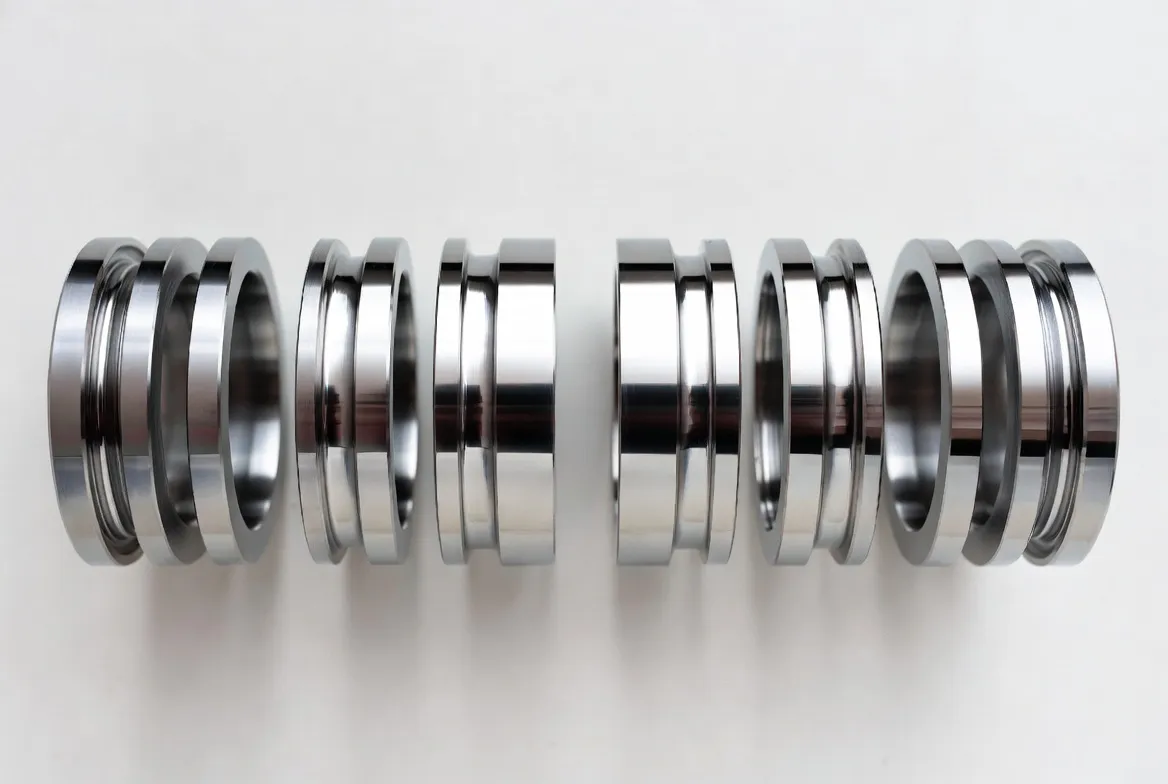
The result is a smoother, brighter surface with improved corrosion resistance due to the enriched chromium oxide passive layer (particularly on stainless steel). Electropolishing is widely used for stainless steel, and can also be applied to certain other alloys. It is valued in industries that demand high cleanliness, low particle generation, and excellent surface integrity.
Advantages of Electropolishing
- Significantly improved corrosion resistance
- Bright, smooth, and uniform surface finish
- Effective removal of burrs and sharp edges
- Enhanced cleanability and hygiene
- Reduced surface friction
- Improved fatigue resistance
- Minimal dimensional change with precise material removal
- Stress relief on the surface layer
Electropolishing FAQs
What chemicals are used in electropolishing?
Electropolishing typically uses an electrolyte based on sulfuric acid and phosphoric acid, sometimes with additional additives. The exact formulation is selected according to the material and the required finish.
Can electropolishing remove rust?
Yes. Electropolishing effectively removes surface oxides, heat tint, and light rust from stainless steel and other suitable metals, leaving a clean and passive surface.
How can you tell if a part has been electropolished?
Electropolished surfaces usually appear bright, smooth, and highly reflective. Burrs and machining marks are significantly reduced, and the surface feels cleaner and less abrasive than a mechanically polished or as-machined finish.
Is electropolished stainless steel food-safe?
Yes. Electropolished stainless steel is widely accepted for food-contact and hygienic applications because the process removes contaminants and improves the passive layer, enhancing cleanability and corrosion resistance.
Does electropolishing significantly change part dimensions?
Material removal is controlled and typically limited to a few micrometers to tens of micrometers. When properly specified, dimensional impact remains minimal and predictable for most precision parts.
Other Surface Finishing Processes
An electrochemical process that creates a durable, corrosion-resistant oxide layer on aluminum, enhancing hardness, wear resistance, and color options.
A surface finishing method that propels fine spherical media to clean, deburr, and create a uniform matte texture without significant material removal.
A chemical conversion coating that forms a thin black magnetite layer on ferrous metals, providing mild corrosion resistance and a non-reflective finish with minimal dimensional change.
A thin diamond-like carbon film applied via PVD or CVD that delivers exceptional hardness, ultra-low friction, and superior wear resistance.
A controlled heating and cooling process used to modify the microstructure of metals, improving hardness, strength, toughness, and overall mechanical performance.
An electroplating process that deposits a uniform nickel layer to enhance corrosion resistance, wear protection, and surface appearance.
A dry finishing process in which electrostatically charged powder is applied and heat-cured to form a durable, uniform, and environmentally friendly protective coating.
A vacuum-based thin-film deposition technique that produces hard, wear-resistant, and often decorative coatings with excellent adhesion and minimal thickness.
An electroplating process that applies a sacrificial zinc layer to steel and iron parts, offering cost-effective corrosion protection through galvanic action.