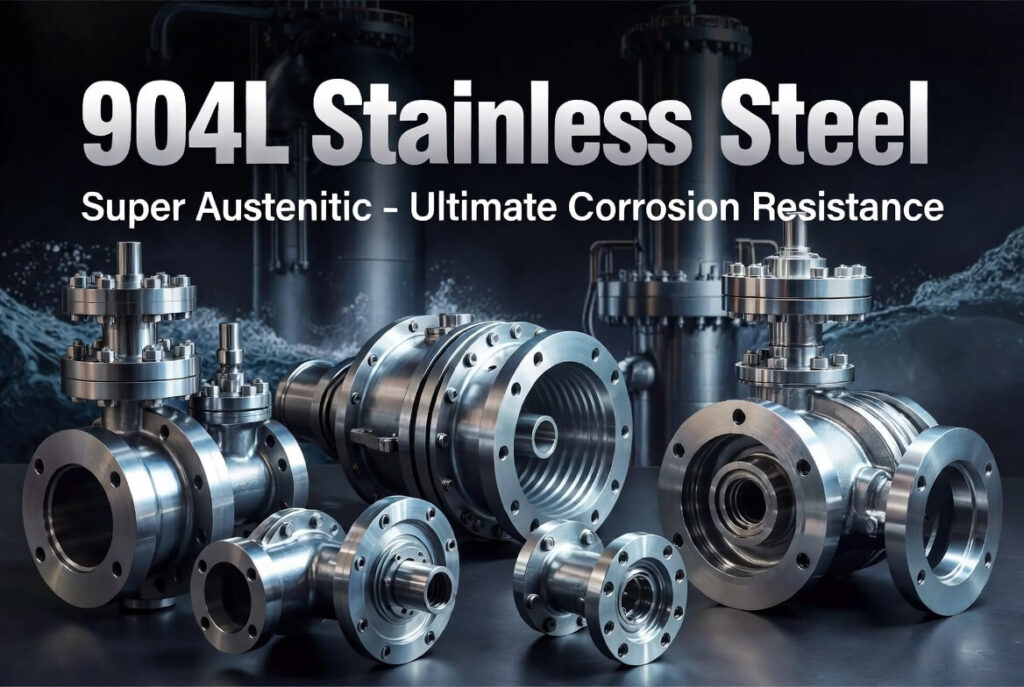
904L stainless steel is a high-alloy, super austenitic stainless steel renowned for its outstanding corrosion resistance in aggressive environments. Often called a “super stainless steel,” it was originally developed for use in the chemical processing and sulfuric acid industries, where standard grades like 316L fall short.
With significantly higher nickel, chromium, molybdenum, and copper content than conventional stainless steels, 904L offers superior resistance to pitting, crevice corrosion, and stress corrosion cracking. This makes it an excellent choice for demanding CNC machined components that must survive harsh chemical, marine, or high-temperature conditions.
This guide covers the key properties of 904L stainless steel, its advantages and limitations, machinability for CNC operations, common applications, and how it compares to 316L and other stainless grades.
Chemical Composition of 904L Stainless Steel
The exceptional performance of 904L comes from its rich alloying elements:
| Element | Percentage (%) |
| Carbon (C) | ≤ 0.020 |
| Chromium (Cr) | 19.0 – 23.0 |
| Nickel (Ni) | 23.0 – 28.0 |
| Molybdenum (Mo) | 4.0 – 5.0 |
| Copper (Cu) | 1.0 – 2.0 |
| Manganese (Mn) | ≤ 2.0 |
| Silicon (Si) | ≤ 1.0 |
| Iron (Fe) | Balance |
The high nickel and molybdenum content, combined with added copper, gives 904L its superior resistance to reducing acids and chloride environments.
Key Mechanical Properties
904L offers a good combination of strength and ductility:
- Tensile Strength: 490 – 690 MPa
- Yield Strength: 220 – 300 MPa
- Elongation: 35 – 50%
- Hardness: 150 – 190 HB (annealed)
- Density: 8.05 g/cm³
While not as strong as some martensitic or duplex grades, 904L provides excellent toughness and formability, making it suitable for complex CNC machined parts.
Corrosion Resistance – The Standout Feature
904L is significantly more corrosion resistant than 316L and most other austenitic stainless steels:
- Excellent resistance to sulfuric acid, phosphoric acid, and organic acids
- Superior performance in seawater and chloride-containing environments
- High resistance to pitting and crevice corrosion
- Good performance in high-temperature oxidizing environments
Because of these properties, 904L is frequently specified for parts that come into contact with aggressive chemicals, hot seawater, or acidic solutions where 316L would corrode prematurely.
Machinability for CNC Operations
904L is more challenging to machine than standard 304 or 316 stainless steel:
- Higher work-hardening tendency
- Increased tool wear due to its high alloy content
- Requires slower cutting speeds, sharp carbide tools (preferably coated), and generous coolant/lubrication
- Best results are achieved when machining in the annealed condition
Despite being tougher to machine than 316L, experienced CNC shops can achieve good surface finishes and tight tolerances with optimized parameters. Proper tool selection and rigid setups are essential for cost-effective production.
Common Applications in CNC Machining
904L stainless steel is chosen for demanding environments where failure is not an option:
- Chemical Processing: Reactors, valves, pumps, and piping components
- Marine & Offshore: Seawater handling equipment, desalination plants, and shipbuilding parts
- Pharmaceutical & Biotech: High-purity vessels, fittings, and processing equipment
- Oil & Gas: Components exposed to sour gas and acidic conditions
- Pulp & Paper Industry: Bleaching equipment and corrosive process parts
- Architectural: High-end coastal structures requiring maximum durability
904L vs 316L Stainless Steel
| Property | 904L Stainless Steel | 316L Stainless Steel |
| Corrosion Resistance | Excellent (superior in acids & chlorides) | Very Good |
| Molybdenum Content | 4.0 – 5.0% | 2.0 – 3.0% |
| Nickel Content | 23 – 28% | 10 – 14% |
| Cost | Significantly higher | Moderate |
| Machinability | More difficult | Good |
| Typical Use | Highly aggressive environments | General corrosive environments |
When to choose 904L: When 316L is not sufficient and maximum corrosion resistance is required, even at a higher cost.
Advantages and Limitations
Advantages:
- Outstanding corrosion resistance in severe environments
- Good mechanical properties and toughness
- Excellent weldability (low carbon version)
- Long service life with minimal maintenance
Limitations:
- Significantly more expensive than 304 or 316
- Harder to machine than standard austenitic grades
- Overkill for many mild or indoor applications
How to Choose 904L for Your CNC Project
Consider 904L stainless steel when your parts will face:
- Strong acids (sulfuric, phosphoric, acetic)
- Hot seawater or high-chloride environments
- Pharmaceutical or high-purity processes
- Long-term exposure where downtime is extremely costly
For general-purpose or moderately corrosive applications, 316L usually provides sufficient performance at a much lower cost.
Ready to machine your components in 904L stainless steel? Our CNC team has extensive experience working with super austenitic grades including 904L. We provide expert material selection advice, optimized machining strategies, and high-quality surface finishing to ensure your parts perform reliably in the most demanding environments. Contact us today for a free quote or technical consultation.
FAQ
What makes 904L stainless steel special? Its very high nickel, molybdenum, and copper content gives it superior resistance to pitting, crevice corrosion, and reducing acids compared to standard stainless steels.
Is 904L better than 316L? Yes, in highly corrosive environments. 904L offers significantly better performance in sulfuric acid, seawater, and chloride-rich conditions, though it costs more.
Is 904L difficult to machine? It is more challenging than 316L due to higher work-hardening. Proper tooling, coolant, and optimized parameters are essential for good results.
Can 904L be used for food or pharmaceutical applications? Yes. It is frequently used in pharmaceutical and high-purity applications because of its excellent corrosion resistance and cleanability.
Does 904L require passivation after machining? Yes. Like other stainless steels, passivation after CNC machining helps restore and enhance its natural corrosion resistance.
Is 904L magnetic? No. Like most austenitic stainless steels, 904L is non-magnetic in the annealed condition.