
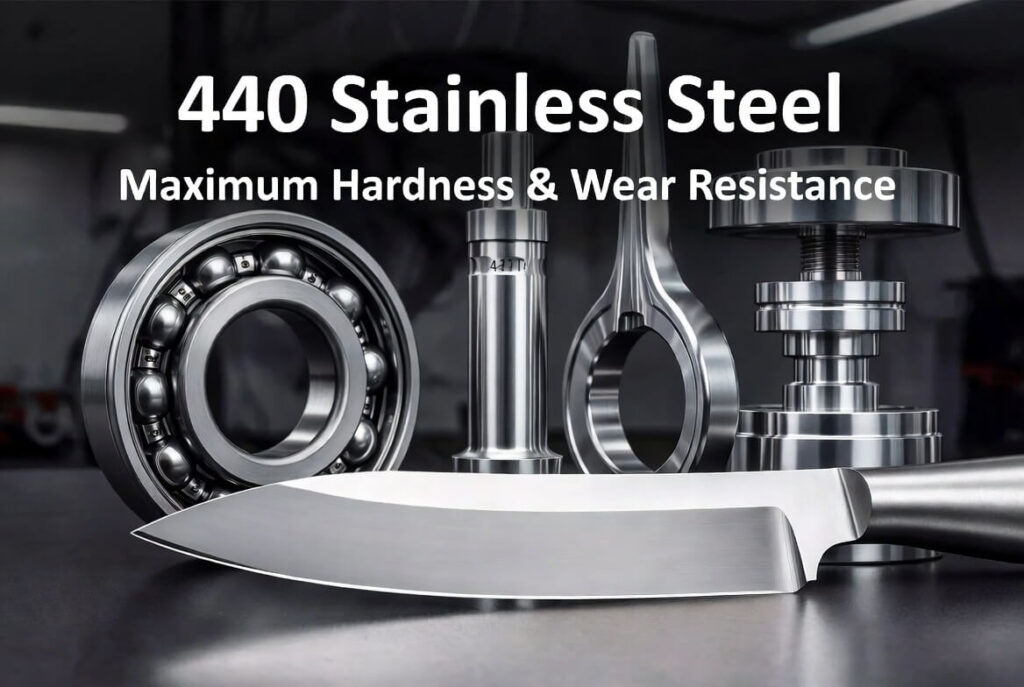
440 stainless steel is a high-carbon martensitic stainless steel family known for delivering excellent hardness, outstanding wear resistance, and impressive edge retention. Engineers and manufacturers often turn to the 440 series when they need CNC machined parts that must hold a sharp edge, resist abrasion, or withstand repeated mechanical stress, all while offering a reasonable level of corrosion protection.
From custom knife blades and ball bearings to surgical instruments and precision valve components, 440 stainless steel — particularly grade 440C — has earned a strong reputation as a go-to material for high-performance cutting tools and wear-resistant parts.
In this guide, we’ll walk through its chemical makeup, the main grade differences, key mechanical properties, heat treatment process, CNC machining considerations, and typical real-world applications to help you decide whether 440 stainless steel is the right choice for your next project.
Chemical Composition
The performance of 440 stainless steel comes largely from its high chromium content (16–18%) paired with carefully controlled carbon levels. The higher the carbon, the more carbides form during heat treatment, which directly boosts hardness and wear resistance.
For the most commonly used grade, 440C, the typical composition looks like this:
| Element | Percentage (%) |
| Carbon (C) | 0.95 – 1.20 |
| Chromium (Cr) | 16.00 – 18.00 |
| Manganese (Mn) | ≤ 1.00 |
| Silicon (Si) | ≤ 1.00 |
| Molybdenum (Mo) | ≤ 0.75 |
| Phosphorus (P) | ≤ 0.04 |
| Sulfur (S) | ≤ 0.03 |
| Iron (Fe) | Balance |
Understanding the 440 Grades: 440A, 440B, and 440C
Although they belong to the same family, the three main grades differ mainly in carbon content, creating a clear trade-off between corrosion resistance, hardness, and ease of machining.
440A has the lowest carbon (0.60–0.75%), giving it the best corrosion resistance and relatively easier machinability in the group. It works well when moderate hardness combined with better toughness is needed. 440B sits in the middle with 0.75–0.95% carbon, offering a balanced set of properties. 440C, with the highest carbon range of 0.95–1.20%, delivers the maximum hardness and superior edge retention, making it the favorite for demanding cutting applications.
In practice, many shops choose 440A when corrosion is a bigger concern, while 440C becomes the go-to option when ultimate wear resistance and sharpness are priorities.
Mechanical Properties After Heat Treatment
Once properly hardened and tempered, 440 stainless steel — especially 440C — shows impressive mechanical performance suited for cutting and wear-heavy roles.
Typical values for hardened 440C include:
| Property | Value |
| Hardness | 58 – 60 HRC |
| Tensile Strength | 760 – 1970 MPa |
| Yield Strength | 450 – 1900 MPa |
| Elongation | 2 – 5% |
| Modulus of Elasticity | ~200 GPa |
While these numbers make 440C excellent for edge retention and abrasion resistance, the material does become noticeably more brittle at peak hardness. Designers should keep this in mind by avoiding overly thin sections or sharp internal corners that could concentrate stress.
Heat Treatment: Unlocking Full Performance
Heat treatment is essential for 440 stainless steel to reach its full potential. The process usually involves three main stages: annealing to soften the material for machining, hardening through high-temperature austenitizing followed by quenching, and tempering to relieve internal stresses and reduce brittleness.
Most experienced machinists prefer to complete the bulk of CNC operations while the material is still in the annealed (softer) state. After heat treatment, only light finishing passes or grinding are typically needed to hit tight tolerances and achieve the desired surface quality. Careful control during quenching is important to minimize the risk of cracking or distortion, particularly on complex geometries.
Corrosion Resistance
Thanks to its 16–18% chromium content, 440 stainless steel develops a protective oxide layer that provides moderate corrosion resistance in mild environments, fresh water, and many acids. It performs significantly better than plain carbon steel, but it cannot match the excellent resistance of austenitic grades like 304 or 316 in aggressive chloride or marine conditions.
Among the series, 440A offers the strongest corrosion performance, while 440C trades a bit of that resistance for higher hardness. Proper passivation and a high-polish finish can further enhance its behavior, especially for medical tools or cutlery that undergo frequent cleaning and sterilization.
CNC Machining Considerations
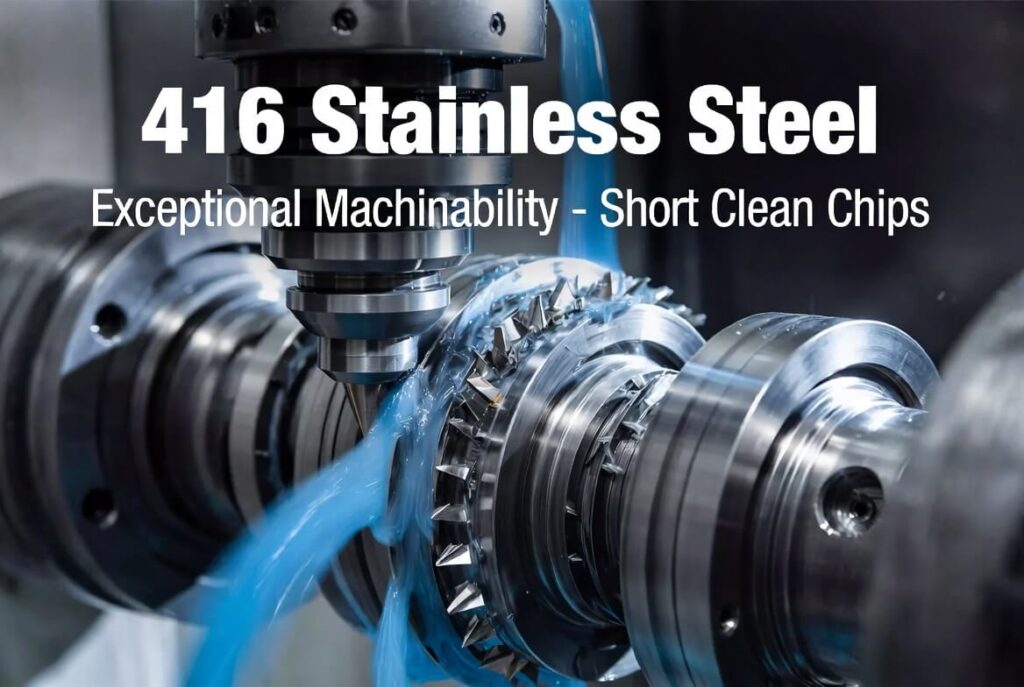
440 stainless steel is moderately challenging to machine, particularly once hardened. The high carbon content and resulting carbides accelerate tool wear, and the material has a tendency to work-harden during cutting.
The smartest approach is to perform all major milling, turning, and drilling while the stock is annealed. This delivers better tool life, faster cycle times, and cleaner results. After heat treatment, you can come back for light finishing if needed. Sharp carbide tools, rigid setups, lower cutting speeds, and plenty of coolant remain key to success.
Common Applications
You’ll find 440 stainless steel in a wide range of CNC machined components that demand a combination of hardness and moderate corrosion resistance. It shines in knife blades, razors, and scissors where edge retention is critical. Industrial uses include ball bearings, valve seats, pump parts, and high-wear machinery components. In the medical field, it appears in surgical scalpels, forceps, and precision dental instruments. It is also used for aerospace fittings, molds, and custom tooling.
For many shops, 440C strikes an attractive balance between performance and cost when producing custom knives or wear-resistant precision parts.
Advantages and Limitations
On the plus side, 440 stainless steel can reach very high hardness levels after heat treatment, offers excellent wear and edge retention properties, and remains more affordable than many premium tool steels. On the downside, it is more difficult to machine than lower-carbon austenitic stainless steels, provides only moderate corrosion resistance in harsh environments, and carries some risk of distortion or cracking during heat treatment due to its reduced ductility in the hardened state.
Choosing the Right Grade for Your Project
When deciding on a 440 grade, start by evaluating your priorities. If maximum hardness and edge retention matter most, go with 440C. When better corrosion resistance and easier machining are needed, 440A is usually the wiser choice. For projects that fall somewhere in between, 440B can provide a good compromise. In most cases, planning to machine in the annealed condition and heat treat afterward leads to the best overall results and tool life.
Ready to bring your 440 stainless steel project to life? Our CNC machining team has extensive experience working with the entire 440 series. Whether you need material guidance, annealed-state machining, precise heat treatment, or tight-tolerance finishing, we’re here to help. Contact us today for a free quote or technical consultation. Let’s deliver durable, high-performance parts tailored to your exact requirements.
FAQ
What is the main difference between 440A, 440B, and 440C? The biggest difference is carbon content. Lower carbon in 440A gives better corrosion resistance and easier machining, while higher carbon in 440C delivers maximum hardness and wear resistance.
Is 440C a good choice for knife blades? Yes, 440C is one of the most popular steels for knives because it holds a sharp edge very well and can reach 58–60 HRC after proper heat treatment.
How hard can 440 stainless steel become? 440C can achieve 58–60 HRC when correctly hardened and tempered, making it one of the hardest stainless steels in everyday use.
Is 440 stainless steel difficult to machine on CNC equipment? It is moderately challenging, especially after hardening. Machining in the annealed state with sharp tools and good coolant makes the process much smoother.
Does 440 stainless steel rust easily? It offers moderate corrosion resistance — better than carbon steel in mild conditions, but not as strong as 304 or 316 stainless in salty or highly corrosive environments.
Should parts be machined before or after heat treatment? It is best to complete the majority of machining while the material is annealed, then heat treat and do only light finishing afterward.
Can 440 stainless steel be used for food-contact applications? Yes, when properly passivated and polished. It is commonly used in cutlery, although 304 stainless is often preferred for general food-processing equipment.