

When selecting stainless steel for CNC machined components, 201 and 304 are two of the most commonly compared austenitic grades. While both offer solid strength and workability, they differ significantly in corrosion resistance, cost, and long-term performance. Choosing incorrectly can result in early rust, increased maintenance, or higher overall project costs.
304 stainless steel remains the industry benchmark for reliability and corrosion resistance, whereas 201 serves as a more affordable alternative that replaces much of the nickel with manganese. This guide breaks down their key differences to help you make the right decision for your CNC parts.
Chemical Composition: Why They Behave Differently
The performance gap between these two grades starts with their alloying elements:
- 201 Stainless Steeluses 16–18% chromium and only 3.5–5.5% nickel, with higher manganese (5.5–7.5%) and nitrogen to maintain the austenitic structure while keeping costs down.
- 304 Stainless Steelcontains higher chromium (18–20%) and nickel (8–10.5%), along with very low carbon (≤0.08%) for improved weldability and corrosion performance.
This higher chromium and nickel content in 304 creates a more stable protective oxide layer on the surface.
Mechanical Properties Comparison
Both grades deliver good strength, but their characteristics differ in practical ways:
| Property | 201 Stainless Steel | 304 Stainless Steel |
| Tensile Strength | 515 – 750 MPa | 505 – 700 MPa |
| Yield Strength | 275 – 450 MPa | 215 – 275 MPa |
| Elongation | 40 – 50% | 40 – 60% |
| Hardness (HRB) | 95 – 100 | 70 – 90 |
201 generally provides higher strength and hardness thanks to its manganese content, but 304 offers better ductility, making it easier to form and less prone to cracking during processing.
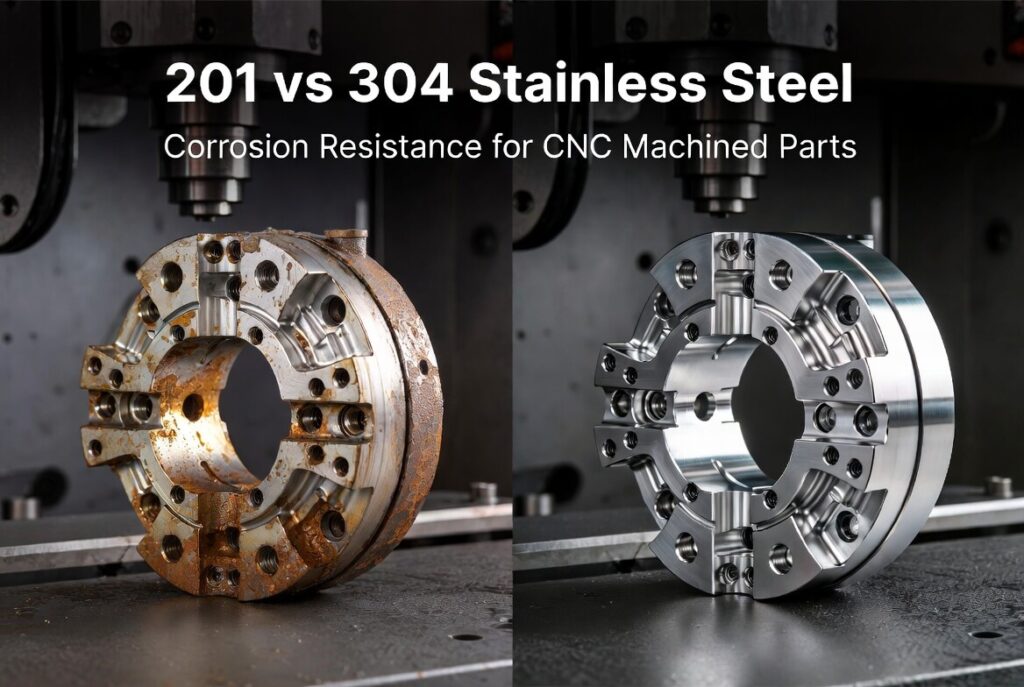
Corrosion Resistance: The Most Important Difference
Corrosion resistance is where these two grades diverge the most:
- 304 Stainless Steeldelivers excellent general corrosion resistance and performs reliably in food processing, architectural, and mildly corrosive environments. It handles chloride exposure much better than 201.
- 201 Stainless Steeloffers only moderate corrosion resistance, making it suitable mainly for indoor, dry, or low-humidity applications such as decorative panels or non-critical trim. It is more susceptible to pitting and rust in moist, salty, or acidic conditions.
For marine, chemical, food-contact, or outdoor CNC parts, 304 is almost always the safer and more durable choice.
Machinability for CNC Machining
Machinability directly affects production efficiency and tooling costs:
- 304 Stainless Steelgenerally machines better overall. It produces cleaner chips, experiences slower work-hardening, and allows for smoother surface finishes with standard carbide tools.
- 201 Stainless Steelcan be more difficult due to its higher hardness and faster work-hardening rate. It often requires optimized speeds, feeds, and rigid setups, though it still performs adequately for many components when proper coolant is used.
In high-volume or precision CNC runs where surface quality matters, 304 frequently results in lower overall machining costs despite its higher material price.
Formability and Weldability
- Formability: 304 excels with superior ductility, making it easier to bend, draw, or form complex shapes without cracking. 201 has decent formability but is less forgiving.
- Weldability: Both grades can be welded, but 304 offers better results with lower risk of carbide precipitation and heat-affected zone issues.
If your parts involve significant bending, deep drawing, or welding in addition to CNC machining, 304 is usually the better option.
Common Applications for CNC Parts
Use 201 Stainless Steel when:
- Cost is the primary concern and the operating environment is mild or indoor
- You need decorative trim, appliance components, or non-critical structural parts
- Higher strength-to-cost ratio is important
Use 304 Stainless Steel when:
- Excellent corrosion resistance is required (food equipment, kitchen sinks, hygienic parts)
- Parts will face outdoor, marine, or chemical exposure
- Long-term reliability and appearance are critical (architectural, medical, or precision components)
Many CNC shops default to 304 for dependable performance and reserve 201 for strictly budget-driven projects with controlled conditions.
Cost Comparison (Material + Total Ownership)
201 stainless steel is typically 20–40% cheaper than 304 due to its lower nickel content. While this makes 201 attractive for cost-sensitive runs, you should consider the full picture: in corrosive environments, 201 may lead to higher maintenance or replacement costs over time. 304 often provides better long-term value through durability and reduced downtime.
How to Choose the Right Grade for Your CNC Project
Ask yourself these key questions:
- Will the part be exposed to moisture, chemicals, or outdoor conditions?
- Is budget or machining efficiency the top priority?
- Do the parts require extensive forming or welding?
- Are tight tolerances and superior surface finish critical?
For dry, indoor, or cost-driven applications, 201 can be a smart choice. For any environment where corrosion resistance and reliability matter, 304 remains the stronger overall performer.
Ready to machine your stainless steel parts with the right grade? Our CNC experts specialize in both 201 and 304 stainless steel. We offer material recommendations, DFM feedback, tight-tolerance machining, and efficient production runs. Contact us today for a free quote or technical consultation and get the best balance of performance and cost for your project.
FAQ
What is the main difference between 201 and 304 stainless steel? The biggest difference is corrosion resistance. 304 has higher chromium and nickel content, giving it superior rust protection, while 201 uses more manganese to reduce cost.
Which grade machines better on CNC equipment? 304 generally offers better machinability with cleaner chips and smoother finishes. 201 can machine well but tends to work-harden faster and may increase tool wear.
Is 201 stainless steel suitable for outdoor use? It is not recommended for outdoor or marine environments due to moderate corrosion resistance. 304 performs much better in these conditions.
Does 304 stainless steel cost more than 201? Yes, 304 is usually 20–40% more expensive because of its higher nickel content.
Can 201 stainless steel be used for food contact applications? It is generally not recommended for direct food contact. 304 is the standard choice for food-grade and hygienic equipment.
Which grade is stronger? 201 typically has higher tensile and yield strength, but 304 provides better overall ductility and long-term reliability.
When should I choose 201 over 304 stainless steel? Choose 201 for indoor, low-corrosion, budget-sensitive projects where maximum corrosion resistance is not required.